

View PCNSA Exam Question Dumps With Latest Demo [Jul 21, 2023]
Free PCNSA Test Questions Real Practice Test Questions
Palo Alto Networks Certified Network Security Administrator (PCNSA) certification exam is designed to test the knowledge and skills required to manage and maintain Palo Alto Networks next-generation firewalls. Palo Alto Networks Certified Network Security Administrator certification program is aimed at individuals who are responsible for the deployment, configuration, and management of Palo Alto Networks firewalls in their organizations. The PCNSA certification exam is an entry-level certification exam that provides a solid foundation for professionals seeking to advance their careers in network security.
NEW QUESTION # 110
Which URL profiling action does not generate a log entry when a user attempts to access that URL?
- A. Override
- B. Block
- C. Continue
- D. Allow
Answer: D
Explanation:
Explanation/Reference: https://docs.paloaltonetworks.com/pan-os/8-0/pan-os-admin/url-filtering/url-filtering-concepts/url- filtering-profile-actions
NEW QUESTION # 111
Which administrator type utilizes predefined roles for a local administrator account?
- A. Dynamic
- B. Device administrator
- C. Superuser
- D. Role-based
Answer: A
Explanation:
Dynamic roles: These are built-in or predefined roles that provide access to the firewall. When new features are added, the firewall automatically updates the definitions of Dynamic roles; you never need to manually update them.
NEW QUESTION # 112
How are Application Fillers or Application Groups used in firewall policy?
- A. An Application Filter is a static way of grouping applications and can be configured as a nested member of an Application Group
- B. An Application Group is a dynamic way of grouping applications and can be configured as a nested member of an Application Group
- C. An Application Filter is a dynamic way to group applications and can be configured as a nested member of an Application Group
- D. An Application Group is a static way of grouping applications and cannot be configured as a nested member of Application Group
Answer: C
NEW QUESTION # 113
Which administrative management services can be configured to access a management interface?
- A. HTTP, CLI, SNMP, HTTPS
- B. SSH: telnet HTTP, HTTPS
- C. HTTPS, SSH telnet SNMP
- D. HTTPS, HTTP. CLI, API
Answer: D
Explanation:
https://docs.paloaltonetworks.com/pan-os/8-1/pan-os-admin/firewall-administration/management-interfaces You can use the following user interfaces to manage the Palo Alto Networks firewall:
Use the Web Interface to perform configuration and monitoring tasks with relative ease. This graphical interface allows you to access the firewall using HTTPS (recommended) or HTTP and it is the best way to perform administrative tasks.
Use the Command Line Interface (CLI) to perform a series of tasks by entering commands in rapid succession over SSH (recommended), Telnet, or the console port. The CLI is a no-frills interface that supports two command modes, operational and configure, each with a distinct hierarchy of commands and statements. When you become familiar with the nesting structure and syntax of the commands, the CLI provides quick response times and administrative efficiency.
Use the XML API to streamline your operations and integrate with existing, internally developed applications and repositories. The XML API is a web service implemented using HTTP/HTTPS requests and responses.
Use Panorama to perform web-based management, reporting, and log collection for multiple firewalls. The Panorama web interface resembles the firewall web interface but with additional functions for centralized management.
NEW QUESTION # 114
Based on the screenshot what is the purpose of the group in User labelled ''it"?
- A. Allows "any" users to access servers in the DMZ zone
- B. Allows users in group "DMZ" lo access IT applications
- C. Allows users to access IT applications on all ports
- D. Allows users in group "it" to access IT applications
Answer: D
NEW QUESTION # 115
What is used to monitor Security policy applications and usage?
- A. Security profile
- B. App-ID
- C. Policy-based forwarding
- D. Policy Optimizer
Answer: D
Explanation:
https://docs.paloaltonetworks.com/pan-os/9-1/pan-os-web-interface-help/policies/policies- security/applications-and-usage
NEW QUESTION # 116
Your company occupies one floor in a single building you have two active directory domain controllers on a single networks the firewall s management plane is only slightly utilized.
Which user-ID agent sufficient in your network?
- A. PAN-OS integrated agent deployed on the firewall
- B. Windows-based agent deployed on each domain controller
- C. Citrix terminal server agent deployed on the network
- D. Windows-based agent deployed on the internal network a domain member
Answer: A
NEW QUESTION # 117
Based on the graphic which statement accurately describes the output shown in the server monitoring panel?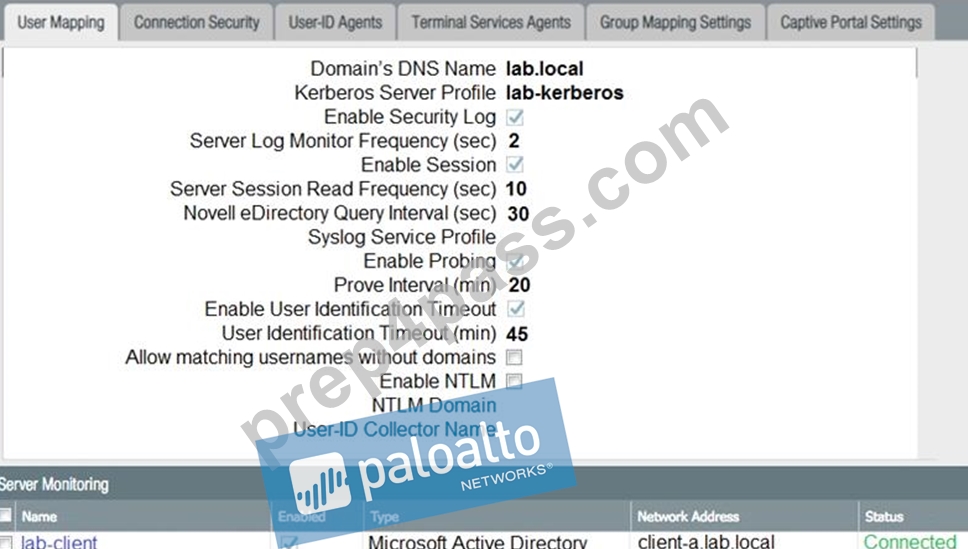
- A. The host lab-client has been found by a domain controller.
- B. The User-ID agent is connected to a domain controller labeled lab-client.
- C. The User-ID agent is connected to the firewall labeled lab-client.
- D. The host lab-client has been found by the User-ID agent.
Answer: A
NEW QUESTION # 118
All users from the internal zone must be allowed only Telnet access to a server in the DMZ zone.
Complete the two empty fields in the Security policy rules that permits only this type of access. (Choose two.) Source Zone: Internal Destination Zone: DMZ Zone Application: _________?
Service: ____________?
Action: allow
- A. Application = "Telnet"
- B. Service = "service-telnet"
- C. Application = "any"
- D. Service = "application-default"
Answer: A,D
NEW QUESTION # 119
During the packet flow process, which two processes are performed in application identification?
(Choose two.)
- A. session application identified
- B. application changed from content inspection
- C. application override policy match
- D. pattern based application identification
Answer: C,D
Explanation:
http://live.paloaltonetworks.com//t5/image/serverpage/image-id/12862i950F549C7D4E6309
NEW QUESTION # 120
An administrator is reviewing another administrator s Security policy log settings Which log setting configuration is consistent with best practices tor normal traffic?
- A. Log at Session Start disabled Log at Session End enabled
- B. Log at Session Start and Log at Session End both enabled
- C. Log at Session Start and Log at Session End both disabled
- D. Log at Session Start enabled Log at Session End disabled
Answer: A
NEW QUESTION # 121
Which URL Filtering Profile action does not generate a log entry when a user attempts to access a URL?
- A. continue
- B. allow
- C. override
- D. block
Answer: B
NEW QUESTION # 122
An administrator creates a new Security policy rule to allow DNS traffic from the LAN to the DMZ zones. The administrator does not change the rule type from its default value.
What type of Security policy rule is created?
- A. Tagged
- B. Intrazone
- C. Universal
- D. Interzone
Answer: C
Explanation:
Policy > Security > Add
Rule type: Universal (default)
NEW QUESTION # 123
An administrator notices that protection is needed for traffic within the network due to malicious lateral movement activity. Based on the image shown, which traffic would the administrator need to monitor and block to mitigate the malicious activity?
- A. branch office traffic
- B. east-west traffic
- C. north-south traffic
- D. perimeter traffic
Answer: B
NEW QUESTION # 124
Assume that traffic matches a Security policy rule but the attached Security Profiles is configured to block matching traffic Which statement accurately describes how the firewall will apply an action to matching traffic?
- A. If it is a block rule then Security Profile action is applied last
- B. If it is a block rule then the Security policy rule action is applied last
- C. If it is an allowed rule, then the Security Profile action is applied last
- D. If it is an allow rule then the Security policy rule is applied last
Answer: C
NEW QUESTION # 125
What is considered best practice with regards to committing configuration changes?
- A. Wait until all running and pending jobs are finished before committing.
- B. Disable the automatic commit feature that prioritizes content database installations before committing.
- C. Validate configuration changes prior to committing.
- D. Export configuration after each single configuration change performed.
Answer: C
Explanation:
https://docs.paloaltonetworks.com/pan-os/11-0/pan-os-cli-quick-start/use-the-cli/commit- configuration-changes As a best practice, validate configuration changes prior to committing so that you can fix any errors that will cause a commit failure, thereby ensuring that the commit will succeed. This is particularly useful in environments with a strict change window.
NEW QUESTION # 126
When HTTPS for management and GlobalProtect are enabled on the same interface, which TCP port is used for management access?
- A. 0
- B. 1
- C. 2
- D. 3
Answer: A
Explanation:
https://knowledgebase.paloaltonetworks.com/KCSArticleDetail?
id=kA10g000000Cm8SCAS#:~:text=Details,using%20https%20on%20port%204443
NEW QUESTION # 127
By default, which action is assigned to the interzone-default rule?
- A. Reset-server
- B. Reset-client
- C. Deny
- D. Allow
Answer: C
NEW QUESTION # 128
All users from the internal zone must be allowed only HTTP access to a server in the DMZ zone.
Complete the empty field in the Security policy using an application object to permit only this type of access.
Source Zone: Internal
Destination Zone: DMZ Zone
Application: __________
Service: application-default
Action: allow
- A. Application = "web-browsing"
- B. Application = "ssl"
- C. Application = "any"
- D. Application = "http"
Answer: A
Explanation:
http is not an application but service, the web-browsing cab be http/https.
NEW QUESTION # 129
What is the main function of Policy Optimizer?
- A. convert port-based security rules to application-based security rules
- B. eliminate "Log at Session Start" security rules
- C. reduce load on the management plane by highlighting combinable security rules
- D. migrate other firewall vendors' security rules to Palo Alto Networks configuration
Answer: A
Explanation:
Policy Optimizer provides a simple workflow to migrate your legacy Security policy rulebase to an App-ID-based rulebase, which improves your security by reducing the attack surface and offering visibility into applications so you can safely enable them. Policy Optimizer identifies port-based rules so you can convert them to application-based whitelist rules or add applications from a port- based rule to an existing application-based rule without compromising application availability. It also identifies over-provisioned App-ID-based rules (App-ID rules configured with unused applications). Policy Optimizer helps you prioritize which port-based rules to migrate first, identify application-based rules that allow applications you do not use, and analyze rule usage characteristics such as hit count.
NEW QUESTION # 130
What are two predefined AntiSpyware profiles? (Choose two.)
- A. Default
- B. Strict
- C. Secure
- D. Standard
Answer: A,B
NEW QUESTION # 131
When creating a Source NAT policy, which entry in the Translated Packet tab will display the options Dynamic IP and Port, Dynamic, Static IP, and None?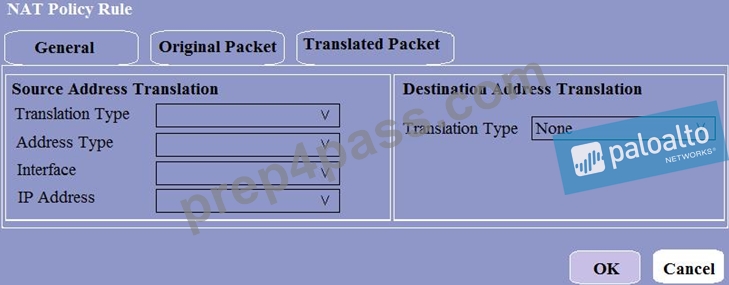
- A. Interface
- B. Address Type
- C. IP Address
- D. Translation Type
Answer: D
NEW QUESTION # 132
......
View All PCNSA Actual Free Exam Questions Updated: https://passguide.prep4pass.com/PCNSA_exam-braindumps.html
