

ECCouncil 212-82 Real Exam Questions Test Engine Dumps Training With 163 Questions
212-82 Actual Questions Answers PDF 100% Cover Real Exam Questions
NEW QUESTION # 89
Rhett, a security professional at an organization, was instructed to deploy an IDS solution on their corporate network to defend against evolving threats. For this purpose, Rhett selected an IDS solution that first creates models for possible intrusions and then compares these models with incoming events to make detection decisions.
Identify the detection method employed by the IDS solution in the above scenario.
- A. Signature recognition
- B. Protocol anomaly detection
- C. Anomaly detection
- D. Not-use detection
Answer: C
Explanation:
Anomaly detection is a type of IDS detection method that involves first creating models for possible intrusions and then comparing these models with incoming events to make a detection decision. It can detect unknown or zero-day attacks by looking for deviations from normal or expected behavior
NEW QUESTION # 90
You recently purchased a smart thermostat for your home. It allows you to control the temperature remotely through a mobile app. Considering the security of your new smart thermostat, which of the following actions would be the LEAST effective In protecting It from unauthorized access?
- A. Keeping the thermostat firmware updated with the latest security patches from the manufacturer.
- B. Changing the default password for the mobile app and thermostat upon initial setup.
- C. Leaving the thermostat connected to the "Guest" Wi-Fi network in your home, which is open to all guests.
- D. Enabling remote access to the thermostat only on your secure home Wi-Fi network.
Answer: C
Explanation:
Leaving the thermostat connected to the "Guest" Wi-Fi network, which is open to all guests, is the least effective action in protecting it from unauthorized access. Here is a detailed explanation:
* Network Segmentation:
* A guest Wi-Fi network is typically designed to provide internet access to visitors without granting access to the main network or its devices. However, if the guest network is open (i.e., no password), it poses significant security risks.
NEW QUESTION # 91
In an advancedcybersecurity research lab. a team Is working on developing a new cryptographicprotocol to secure highly sensitive communication. Their goal is to create aprotocol that is resilient against quantum computing attacks, which couldpotentially break many current encryption methods. During their research, theyfocus on the use of hash functions in their protocol. The team experiments withvarious hash functions to ensure the highest level of security. Considering thethreat of quantum computing, which of the following hash functions would be themost appropriate choice fortheir protocol?
- A. MD5, for its speed and efficiency in generating hash values
- B. HMAC. for its ability to provide data integrity and authentication
- C. SHA-256, due to its widespread use and proven security track record
- D. SHA-3. as it is designed to be resistant against quantum computing attacks
Answer: D
Explanation:
In the context of developing a cryptographic protocol resilient against quantum computing attacks, SHA-3 is the most appropriate choice. Here's why:
* Quantum Computing Threats: Quantum computers can potentially break current cryptographic methods like RSA and ECC due to Shor's algorithm. Traditional hash functions like SHA-256 might not offer sufficient security in a post-quantum world.
* SHA-3 Overview: SHA-3, part of the Secure Hash Algorithm family, was designed with quantum resistance in mind. It was selected through an open competition by NIST, ensuring it incorporates advanced cryptographic techniques.
* Resilience: SHA-3's design is fundamentally different from SHA-2, providing enhanced security properties, including resistance to various attack vectors that might be feasible with quantum computing advancements.
References:
* NIST SHA-3 Standard:NIST FIPS PUB 202
* Research on quantum-resistant cryptography:IEEE Xplore
NEW QUESTION # 92
Jordan, a network administrator in an organization, was instructed to identify network-related issues and improve network performance. While troubleshooting the network, he received a message indicating that the datagram could not be forwarded owing to the unavailability of IP-related services (such as FTP or web services) on the target host, which of the following network issues did Jordan find in this scenario?
- A. Destination unreachable message
- B. Time exceeded message
- C. Unreachable networks
- D. Network cable is unplugged
Answer: A
Explanation:
Destination unreachable message is the network issue that Jordan found in this scenario. Destination unreachable message is a type of ICMP message that indicates that the datagram could not be forwarded owing to the unavailability of IP-related services (such as FTP or web services) on the target host. Destination unreachable message can be caused by various reasons, such as incorrect routing, firewall blocking, or host configuration problems1.
NEW QUESTION # 93
Brielle. a security professional, was instructed to secure her organization's network from malicious activities.
To achieve this, she started monitoring network activities on a control system that collected event data from various sources. During this process. Brielle observed that a malicious actor had logged in to access a network device connected to the organizational network. Which of the following types of events did Brielle identify in the above scenario?
- A. Warning
- B. Success audit
- C. Error
- D. Failure audit
Answer: B
Explanation:
Success audit is the type of event that Brielle identified in the above scenario. Success audit is a type of event that records successful attempts to access a network device or resource. Success audit can be used to monitor authorized activities on a network, but it can also indicate unauthorized activities by malicious actors who have compromised credentials or bypassed security controls4.
References: Success Audit Event
NEW QUESTION # 94
Andre, a security professional, was tasked with segregating the employees' names, phone numbers, and credit card numbers before sharing the database with clients. For this purpose, he implemented a deidentification technique that can replace the critical information in database fields with special characters such as asterisks (*) and hashes (#).
Which of the following techniques was employed by Andre in the above scenario?
- A. Bucketing
- B. Hashing
- C. Tokenization
- D. Masking
Answer: D
NEW QUESTION # 95
Steve, a network engineer, was tasked with troubleshooting a network issue that is causing unexpected packet drops. For this purpose, he employed a network troubleshooting utility to capture the ICMP echo request packets sent to the server. He identified that certain packets are dropped at the gateway due to poor network connection.
Identify the network troubleshooting utility employed by Steve in the above scenario.
- A. dnsenurn
- B. arp
- C. traceroute
- D. ipconfig
Answer: C
Explanation:
Traceroute is the network troubleshooting utility employed by Steve in the above scenario. Traceroute is a utility that traces the route of packets from a source host to a destination host over a network. Traceroute sends ICMP echo request packets with increasing TTL (Time to Live) values and records the ICMP echo reply packets from each intermediate router or gateway along the path. Traceroute can help identify the network hops, latency, and packet loss between the source and destination hosts . Dnsenum is a utility that enumerates DNS information from a domain name or an IP address. Arp is a utility that displays and modifies the ARP (Address Resolution Protocol) cache of a host. Ipconfig is a utility that displays and configures the IP (Internet Protocol) settings of a host.
NEW QUESTION # 96
A software company is developing a new software product by following the best practices for secure application development. Dawson, a software analyst, is checking the performance of the application on the client's network to determine whether end users are facing any issues in accessing the application.
Which of the following tiers of a secure application development lifecycle involves checking the performance of the application?
- A. Testing
- B. Development
- C. Staging
- D. Quality assurance (QA)
Answer: A
Explanation:
The testing tier of a secure application development lifecycle involves checking the performance of the application on the client's network to determine whether end users are facing any issues in accessing the application. Testing is a crucial phase of software development that ensures the quality, functionality, reliability, and security of the application. Testing can be done manually or automatically using various tools and techniques, such as unit testing, integration testing, system testing, regression testing, performance testing, usability testing, security testing, and acceptance testing
NEW QUESTION # 97
Jase. a security team member at an organization, was tasked with ensuring uninterrupted business operations under hazardous conditions. Thus, Jase implemented a deterrent control strategy to minimize the occurrence of threats, protect critical business areas, and mitigate the impact of threats. Which of the following business continuity and disaster recovery activities did Jase perform in this scenario?
- A. Response
- B. Recovery
- C. Prevention
- D. Restoration
Answer: C
Explanation:
Prevention is the business continuity and disaster recovery activity performed by Jase in this scenario.
Prevention is an activity that involves implementing a deterrent control strategy to minimize the occurrence of threats, protect critical business areas, and mitigate the impact of threats. Prevention can include measures such as backup systems, firewalls, antivirus software, or physical security1. References: Prevention Activity in BCDR
NEW QUESTION # 98
Ruben, a crime investigator, wants to retrieve all the deleted files and folders in the suspected media without affecting the original files. For this purpose, he uses a method that involves the creation of a cloned copy of the entire media and prevents the contamination of the original medi a.
Identify the method utilized by Ruben in the above scenario.
- A. Drive decryption
- B. Logical acquisition
- C. Sparse acquisition
- D. Bit-stream imaging
Answer: D
NEW QUESTION # 99
Lorenzo, a security professional in an MNC, was instructed to establish centralized authentication, authorization, and accounting for remote-access servers. For this purpose, he implemented a protocol that is based on the client-server model and works at the transport layer of the OSI model.
Identify the remote authentication protocol employed by Lorenzo in the above scenario.
- A. POP3S
- B. SNMPv3
- C. IMAPS
- D. RADIUS
Answer: D
Explanation:
The correct answer is B, as it identifies the remote authentication protocol employed by Lorenzo in the above scenario. RADIUS (Remote Authentication Dial-In User Service) is a protocol that provides centralized authentication, authorization, and accounting (AAA) for remote-access servers such as VPNs (Virtual Private Networks), wireless networks, or dial-up connections. RADIUS is based on the client-server model and works at the transport layer of the OSI model. RADIUS uses UDP (User Datagram Protocol) as its transport protocol and encrypts only user passwords in its messages. In the above scenario, Lorenzo implemented RADIUS to provide centralized AAA for remote-access servers. Option A is incorrect, as it does not identify the remote authentication protocol employed by Lorenzo in the above scenario. SNMPv3 (Simple Network Management Protocol version 3) is a protocol that provides network management and monitoring for network devices such as routers, switches, servers, or printers. SNMPv3 is basedon the manager-agent model and works at the application layer of the OSI model. SNMPv3 uses UDP as its transport protocol and encrypts all its messages with AES (Advanced Encryption Standard) or DES (Data Encryption Standard). In the above scenario, Lorenzo did not implement SNMPv3 to provide network management and monitoring for network devices.
Option C is incorrect, as it does not identify the remote authentication protocol employed by Lorenzo in the above scenario. POP3S (Post Office Protocol version 3 Secure) is a protocol that provides secure email access and retrieval for email clients from email servers. POP3S is based on the client-server model and works at the application layer of the OSI model. POP3S uses TCP (Transmission Control Protocol) as its transport protocol and encrypts all its messages with SSL (Secure Sockets Layer) or TLS (Transport Layer Security). In the above scenario, Lorenzo did not implement POP3S to provide secure email access and retrieval for email clients from email servers. Option D is incorrect, as it does not identify the remote authentication protocol employed by Lorenzo in the above scenario. IMAPS (Internet Message Access Protocol Secure) is a protocol that provides secure email access and management for email clients from email servers. IMAPS is based on the client-server model and works at the application layer of the OSI model. IMAPS uses TCP as its transport protocol and encrypts all its messages with SSL or TLS. In the above scenario, Lorenzo did not implement IMAPS to provide secure email access and management for email clients from email servers.
References: , Section 8.2
NEW QUESTION # 100
Miguel, a professional hacker, targeted an organization to gain illegitimate access to its critical information. He identified a flaw in the end-point communication that can disclose the target application's dat a.
Which of the following secure application design principles was not met by the application in the above scenario?
- A. Exception handling
- B. Do not trust user input
- C. Fault tolerance
- D. Secure the weakest link
Answer: A
NEW QUESTION # 101
Nancy, a security specialist, was instructed to identify issues related to unexpected shutdown and restarts on a Linux machine. To identify the incident cause, Nancy navigated to a directory on the Linux system and accessed a log file to troubleshoot problems related to improper shutdowns and unplanned restarts.
Identify the Linux log file accessed by Nancy in the above scenario.
- A. /var/log/lighttpd/
- B. /var/log/secure
- C. /var/log/kern.log
- D. /var/log/boot.log
Answer: D
Explanation:
/var/log/boot.log is the Linux log file accessed by Nancy in the above scenario. Linux is an open-source operating system that logs various events and activities on the system or network. Linux log files are stored in the /var/log directory, which contains different types of log files for different purposes. /var/log/boot.log is the type of log file that records events related to the booting process of the Linux system, such as loading drivers, services, modules, etc. /var/log/boot.log can help identify issues related to unexpected shutdowns and restarts on a Linux machine . /var/log/secure is the type of log file that records events related to security and authentication, such as logins, logouts, password changes, sudo commands, etc. /var/log/kern.log is the type of log file that records events related to the kernel, such as kernel messages, errors, warnings, etc. /var/log/lighttpd/ is the directory that contains log files related to the lighttpd web server, such as access logs, error logs, etc.
NEW QUESTION # 102
You are Harris working for a web development company. You have been assigned to perform a task for vulnerability assessment on the given IP address 20.20.10.26. Select the vulnerability that may affect the website according to the severity factor.
Hint: Greenbone web credentials: admin/password
- A. FTP Unencrypted Cleartext Login
- B. UDP timestamps
- C. TCP timestamps
- D. Anonymous FTP Login Reporting
Answer: A
Explanation:
FTP Unencrypted Cleartext Login is the vulnerability that may affect the website according to the severity factor in the above scenario. A vulnerability is a weakness or flaw in a system or network that can be exploited by an attacker to compromise its security or functionality. A vulnerability assessment is a process that involves identifying, analyzing, and evaluating vulnerabilities in a system or network using various tools and techniques. Greenbone is a tool that can perform vulnerability assessment on various targets using various tests and scans. To perform a vulnerability assessment on the given IP address 20.20.10.26, one has to follow these steps:
Open a web browser and type 20.20.10.26:9392
Press Enter key to access the Greenbone web interface.
Enter admin as username and password as password.
Click on Login button.
Click on Scans menu and select Tasks option.
Click on Start Scan icon next to IP Address Scan task.
Wait for the scan to complete and click on Report icon next to IP Address Scan task.
Observe the vulnerabilities found by the scan.
The vulnerabilities found by the scan are: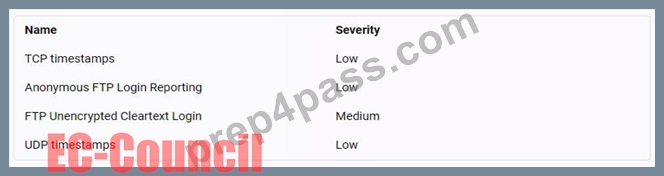
The vulnerability that may affect the website according to the severity factor is FTP Unencrypted Cleartext Login, which has a medium severity level. FTP Unencrypted Cleartext Login is a vulnerability that allows an attacker to intercept or sniff FTP login credentials that are sent in cleartext over an unencrypted connection. An attacker can use these credentials to access or modify files or data on the FTP server. TCP timestamps and UDP timestamps are vulnerabilities that allow an attacker to estimate the uptime of a system or network by analyzing the timestamp values in TCP or UDP packets. Anonymous FTP Login Reporting is a vulnerability that allows an attacker to access an FTP server anonymously without providing any username or password.
NEW QUESTION # 103
Myles, a security professional at an organization, provided laptops for all the employees to carry out the business processes from remote locations. While installing necessary applications required for the business, Myles has also installed antivirus software on each laptop following the company's policy to detect and protect the machines from external malicious events over the Internet.
Identify the PCI-DSS requirement followed by Myles in the above scenario.
- A. PCI-DSS requirement no 1.3.1
- B. PCI-DSS requirement no 1.3.5
- C. PCI-DSS requirement no 5.1
- D. PCI-DSS requirement no 1.3.2
Answer: C
NEW QUESTION # 104
Kaison. a forensic officer, was investigating a compromised system used for various online attacks. Kaison initiated the data acquisition process and extracted the data from the systems DVD-ROM. Which of the following types of data did Kaison acquire in the above scenario?
- A. ARP cache
- B. Archival media
- C. Kernel statistics
- D. Processor cache
Answer: B
Explanation:
Archival media is the type of data that Kaison acquired in the above scenario. Archival media is a type of data that is stored on removable media such as DVD-ROMs, CD-ROMs, tapes, or flash drives. Archival media can be used to backup or transfer data from one system to another. Archival media can be acquired using forensic tools that can read and copy the data from the media4. Reference: Archival Media
NEW QUESTION # 105
An organization divided its IT infrastructure into multiple departments to ensure secure connections for data access. To provide high-speed data access, the administrator implemented a PAID level that broke data into sections and stored them across multiple drives. The storage capacity of this RAID level was equal to the sum of disk capacities in the set. which of the following RAID levels was implemented by the administrator in the above scenario?
- A. RAID Level 1
- B. RAID Level 0
- C. RAID Level 5
- D. RAID Level 3
Answer: B
Explanation:
RAID Level 0 is the RAID level that was implemented by the administrator in the above scenario. RAID Level 0 is also known as striping, which breaks data into sections andstores them across multiple drives. RAID Level 0 provides high-speed data access and increases performance, but it does not provide any redundancy or fault tolerance. The storage capacity of RAID Level 0 is equal to the sum of disk capacities in the set3.
References: RAID Level 0
NEW QUESTION # 106
Shawn, a forensic officer, was appointed to investigate a crime scene that had occurred at a coffee shop. As a part of investigation, Shawn collected the mobile device from the victim, which may contain potential evidence to identify the culprits.
Which of the following points must Shawn follow while preserving the digital evidence? (Choose three.)
- A. Turn the device ON if it is OFF
- B. Do not leave the device as it is if it is ON
- C. Never record the screen display of the device
- D. Make sure that the device is charged
Answer: A,B,D
NEW QUESTION # 107
NovusCorp, a leading healthcare provider, had meticulously designed its BC and DR plans, ensuring every potential risk was covered. Recently, its primary data center experienced a catastrophic flood. It swiftly activated its DR plan, transferring operations to its secondary data center. But within 24 hours, the provider faced an unforeseen challenge: the secondary data center began to receive a huge, unprecedented amount of data requests, causing system overloads and disruptions. This situation was not a part of the provider's initial risk assessment. In the face of this predicament, what should NovusCorp's immediate course of action be to ensure business continuity?
- A. Engage a cloud based data storage provider for temporary overflow until the primary center is restored.
- B. Initiate an immediate Tailback to the primary data center despite potential risks.
- C. Reduce non-critical data requests and impose temporary restrictions on data access to maintain system stability.
- D. Allocate resources to upgrade the secondary data center's infrastructure to handle the increased data request loads.
Answer: A
Explanation:
* Engaging a cloud-based data storage provider allows NovusCorp to manage the sudden influx of data requests without overloading the secondary data center. Cloud providers can quickly scale resources to meet demand.
NEW QUESTION # 108
An advanced persistent threat (APT) group known for Its stealth and sophistication targeted a leading software development company. The attack was meticulously planned and executed over several months. It involved exploiting vulnerabilities at both the application level and the operating system level. The attack resulted in the extraction of sensitive source code anddisruption of development operations. Post-incident analysis revealed multiple attack vectors, including phishing, exploitation of unknown/unpatched vulnerabilities in software/hardware. and lateral movement within the network. Given the nature and execution of this attack, what was the primary method used by the attackers to initiate this APT?
- A. Exploiting default passwords to gain initial access to the network.
- B. Compromising a third-party vendor with access to the company's development environment.
- C. Exploiting a known vulnerability in the firewall to bypass network defenses.
- D. Exploiting a zero-day vulnerability in the application used by developers.
Answer: D
Explanation:
* Definition of Zero-Day Vulnerability:
* A zero-day vulnerability is a flaw in software that is unknown to the vendor and thus has no patch available. Exploiting such a vulnerability allows attackers to infiltrate systems without detection.
NEW QUESTION # 109
Ruben, a crime investigator, wants to retrieve all the deleted files and folders in the suspected media without affecting the original files. For this purpose, he uses a method that involves the creation of a cloned copy of the entire media and prevents the contamination of the original media.
Identify the method utilized by Ruben in the above scenario.
- A. Drive decryption
- B. Logical acquisition
- C. Sparse acquisition
- D. Bit-stream imaging
Answer: D
Explanation:
Bit-stream imaging is the method utilized by Ruben in the above scenario. Bit-stream imaging is a method that involves creating a cloned copy of the entire media and prevents the contamination of the original media. Bit-stream imaging copies all the data on the media, including deleted files and folders, hidden partitions, slack space, etc., at a bit level. Bit-stream imaging preserves the integrity and authenticity of the digital evidence and allows further analysis without affecting the original media. Sparse acquisition is a method that involves creating a partial copy of the media by skipping empty sectors or blocks. Drive decryption is a method that involves decrypting an encrypted drive or partition using a password or a key. Logical acquisition is a method that involves creating a copy of the logical files and folders on the media using file system commands.
NEW QUESTION # 110
Jaden, a network administrator at an organization, used the ping command to check the status of a system connected to the organization's network. He received an ICMP error message stating that the IP header field contains invalid information. Jaden examined the ICMP packet and identified that it is an IP parameter problem.
Identify the type of ICMP error message received by Jaden in the above scenario.
- A. Type = 5
- B. Type =12
- C. Type = 8
- D. Type = 3
Answer: A
NEW QUESTION # 111
Stella purchased a smartwatch online using her debit card. After making payment for the product through the payment gateway, she received a transaction text message with a deducted and available balance from her bank.
Identify the information security element that ensures that Stella's transaction status is immediately reflected in her bank account in this scenario.
- A. Integrity
- B. Availability
- C. Confidentiality
- D. Non-repudiation
Answer: B
Explanation:
Availability is the information security element that ensures that Stella's transaction status is immediately reflected in her bank account in this scenario. Information security is the practice of protecting information and information systems from unauthorized access, use, disclosure, modification, or destruction. Information security can be based on three fundamental principles: confidentiality, integrity, and availability.
Confidentiality is the principle that ensures that information is accessible only to authorized parties and not disclosed to unauthorized parties. Integrity is the principle that ensures that information is accurate, complete, and consistent and not altered or corrupted by unauthorized parties. Availability is the principle that ensures that information and information systems are accessible and usable by authorized parties when needed. In the scenario, Stella purchased a smartwatch online using her debit card. After making payment for the product through the payment gateway, she received a transaction text message with a deducted and available balance from her bank. This means that her transaction status was immediately reflected in her bank account, which indicates that availability was ensured by her bank's information system.
NEW QUESTION # 112
......
Prep4pass 212-82 Exam Practice Test Questions: https://passguide.prep4pass.com/212-82_exam-braindumps.html
