

2023 Easily pass MD-102 Exam with our Dumps & PDF Test Engine
MD-102 PDF Pass Leader, MD-102 Latest Real Test
NEW QUESTION # 31
You have a Microsoft 365 subscription that includes Microsoft Intune.
You need to implement a Microsoft Defender for Endpoint solution that meets the following requirements:
* Enforces compliance for Defender for Endpoint by using Conditional Access
* Prevents suspicious scripts from running on devices
What should you configure? To answer, drag the appropriate features to the correct requirements. Each feature may be used once, more than once, or not at all. You may need to drag the split bar between panes or scroll to view content.
NOTE: Each correct selection is worth one point.
Answer:
Explanation:
Explanation
To enforce compliance for Defender for Endpoint by using Conditional Access, you need to configure an Intune connection in the Defender for Endpoint portal. This allows you to use Intune device compliance policies to evaluate the health and compliance status of devices that are enrolled in Defender for Endpoint.
You can then use Conditional Access policies to block or allow access to cloud apps based on the device compliance status. References:
https://docs.microsoft.com/en-us/windows/security/threat-protection/microsoft-defender-atp/conditional-access To prevent suspicious scripts from running on devices, you need to configure an attack surface reduction (ASR) rule in Intune. ASR rules are part of the endpoint protection settings that you can apply to devices by using device configuration profiles. You can use the ASR rule "Block Office applications from creating child processes" to prevent Office applications from launching child processes such as scripts or executables.
References:
https://docs.microsoft.com/en-us/mem/intune/protect/endpoint-protection-windows-10#attack-surface-reduction-
NEW QUESTION # 32
You have a Microsoft 365 tenant that contains the objects shown in the following table.
You are creating a compliance policy named Compliance1.
Which objects can you specify in Compliance1 as additional recipients of noncompliance notifications?
- A. Group1, Group2, Group3, and Group4 only
- B. Group3 and Group4 only
- C. Group1, Group2, Group3, Group4, and Admin1
- D. Group1, Group2, and Group3 only
- E. Group3, Group4, and Admin1 only
Answer: D
Explanation:
Reference:
https://www.ravenswoodtechnology.com/microsoft-intune-compliance-notifications/
https://docs.microsoft.com/en-us/microsoft-365/admin/create-groups/compare-groups?view=o365-worldwide
NEW QUESTION # 33
You have a Microsoft 365 tenant.
You have devices enrolled in Microsoft Intune.
You assign a conditional access policy named Policy1 to a group named Group1. Policy! restricts devices marked as noncompliant from accessing Microsoft OneDrive for Business.
You need to identify which noncompliant devices attempt to access OneDrive for Business. What should you do?
- A. From the Microsoft Intune admin center, review the Noncompliant devices report.
- B. From the Microsoft Entra admin center, review the Conditional Access Insights and Reporting workbook.
- C. From the Microsoft Intune admin center, review Device compliance report.
- D. From the Microsoft Intune admin center, review the Setting compliance report.
Answer: A
NEW QUESTION # 34
You have a Microsoft 365 subscription.
You have 10 computers that run Windows 10 and are enrolled in mobile device management (MDM).
You need to deploy the Microsoft 36S Apps for enterprise suite to all the computers.
What should you do?
- A. From the Microsoft Intune admin center, add an app.
- B. From Azure AD. add an enterprise application.
- C. From Azure AD, add an app registration.
- D. From the Microsoft Intune admin center, create a Windows 10 device profile.
Answer: A
Explanation:
To deploy Microsoft 365 Apps for enterprise to Windows 10 devices that are enrolled in Intune, you need to add an app of type "Windows 10 app (Win32)" in the Microsoft Intune admin center and configure the app settings. You can then assign the app to groups of users or devices. Reference: https://docs.microsoft.com/en-us/mem/intune/apps/apps-win32-app-management
NEW QUESTION # 35
You have a Microsoft 365 tenant and an internal certification authority (CA).
You need to use Microsoft Intune to deploy the root CA certificate to managed devices.
Which type of Intune policy and profile should you use? To answer, select the appropriate options in the answer area.
NOTE: Each correct selection is worth one point.
Answer:
Explanation:
Explanation
Box 1: Configuration profile
Create a trusted certificate profile.
Box 2: Trusted certificate
When using Intune to provision devices with certificates to access your corporate resources and network, use a trusted certificate profile to deploy the trusted root certificate to those devices. Trusted root certificates establish a trust from the device to your root or intermediate (issuing) CA from which the other certificates are issued.
Reference: https://docs.microsoft.com/en-us/mem/intune/protect/certificates-trusted-root
NEW QUESTION # 36
You have groups that use the Dynamic Device membership type as shown in the following table.
You are deploying Microsoft 365 apps.
You have devices enrolled in Microsoft Intune as shown in the following table.
In the Microsoft Endpoint Manager admin center, you create a Microsoft 365 Apps app as shown in the exhibit. (Click the Exhibit tab.)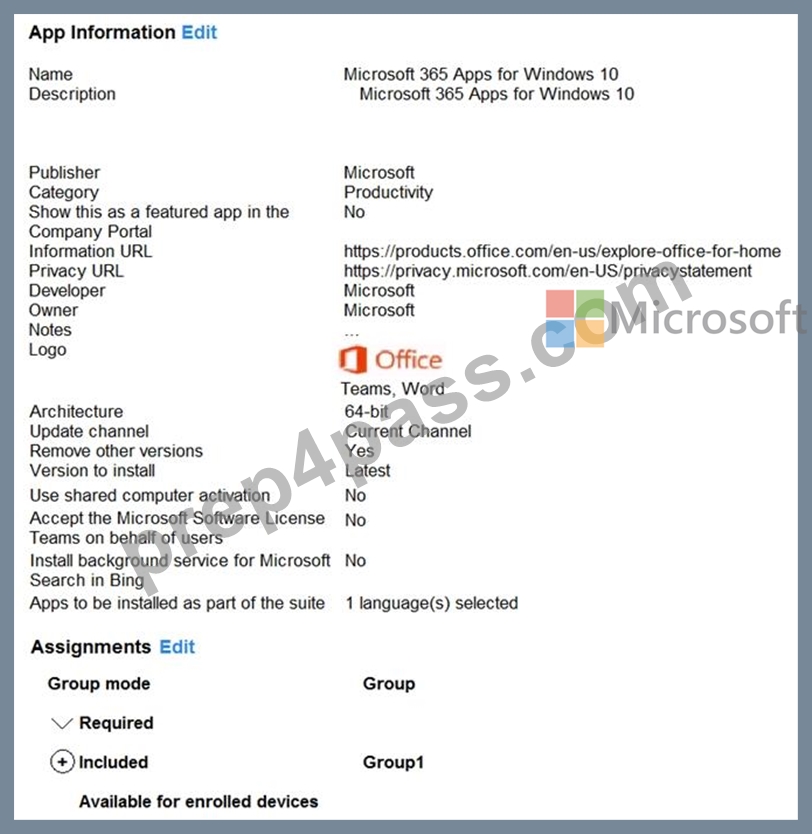
For each of the following statements, select Yes if the statement is true. Otherwise, select No.
NOTE: Each correct selection is worth one point.
Answer:
Explanation: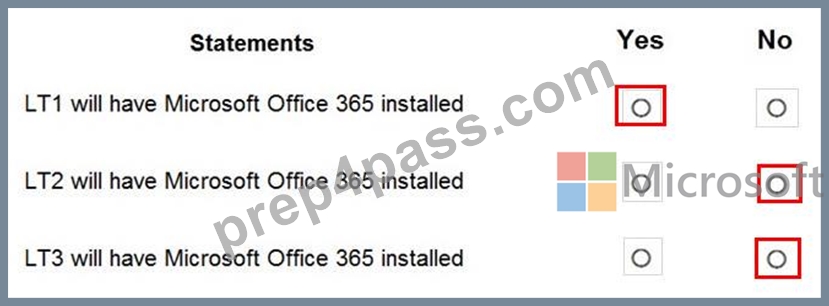
Reference:
https://docs.microsoft.com/en-us/mem/intune/apps/apps-add-office365
https://docs.microsoft.com/en-us/mem/intune/apps/apps-deploy
https://docs.microsoft.com/en-us/mem/intune/apps/apps-add
NEW QUESTION # 37
You have an Azure AD tenant named contoso.com that contains the devices shown in the following table.
The tenant contains the Azure AD groups shown in the following table.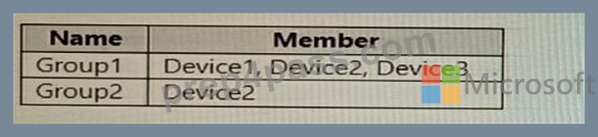
You add an Autopilot deployment profile as shown in the following exhibit.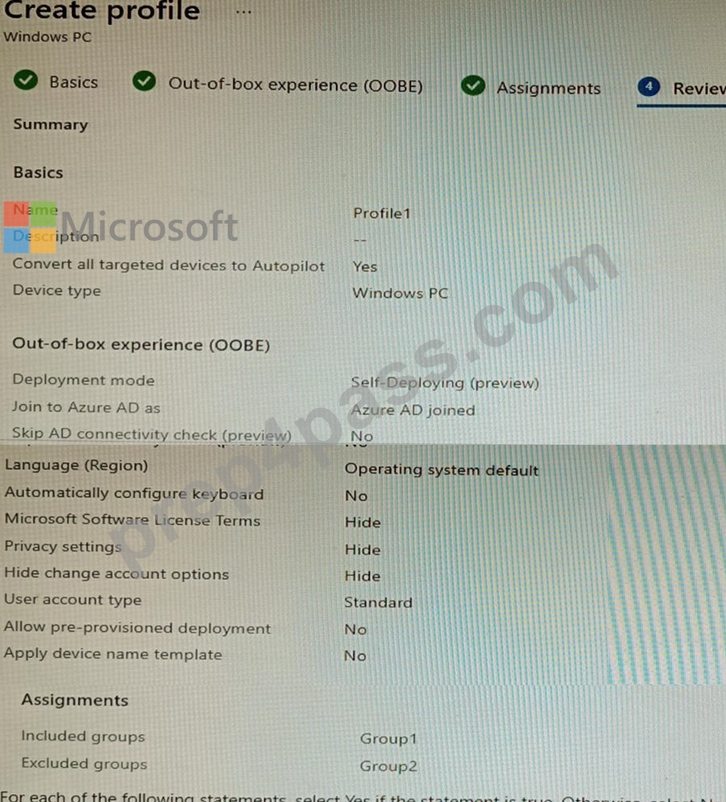
You have an Azure AD tenant named contoso.com that contains the devices shown in the following table.
The tenant contains the Azure AD groups shown in the following table.
Answer:
Explanation: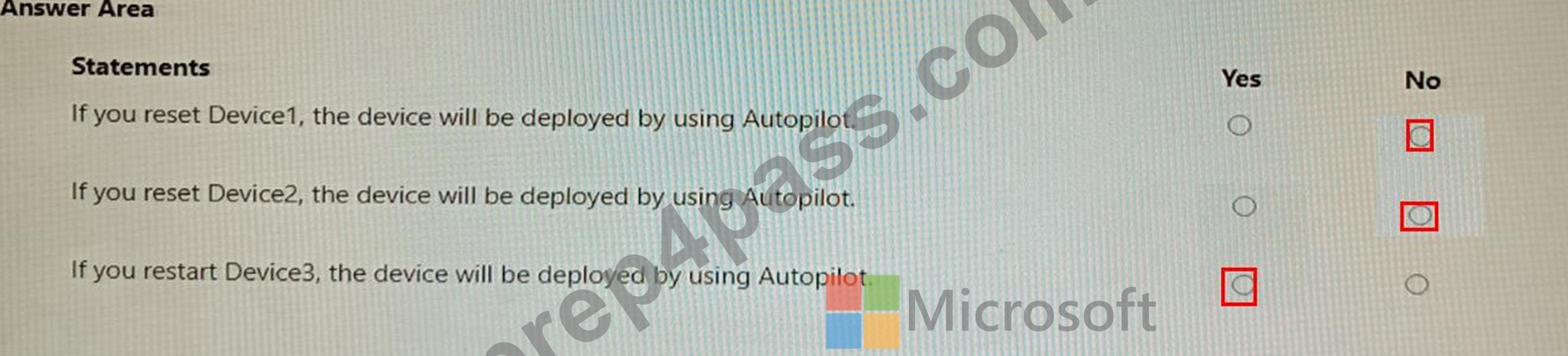
NEW QUESTION # 38
You have an Azure AD tenant named contoso.com.
You need to ensure that users are not added automatically to the local Administrators group when they join their Windows 11 device to contoso.com.
What should you configure?
- A. Security defaults in Azure AD
- B. Windows Autopilot
- C. provisioning packages for Windows
- D. Device settings in Azure AD
Answer: D
Explanation:
Explanation
To ensure that users are not added automatically to the local Administrators group when they join their Windows 11 device to contoso.com, you should configure the Device settings in Azure AD. The Device settings allow you to manage which users can join devices to Azure AD and whether they are added as local administrators or standard users. By default, users who join devices to Azure AD are added to the local Administrators group, but you can change this setting to None or Selected1.
The other options are not relevant for this scenario because:
Windows Autopilot is a service that allows you to pre-configure new devices and enroll them automatically to Azure AD and Microsoft Intune. It does not control the local administrator role of the users who join the devices2.
Provisioning packages for Windows are files that contain custom settings and policies that can be applied to Windows devices during the setup process. They do not affect the Azure AD join process or the local administrator role of the users3.
Security defaults in Azure AD are a set of basic identity security mechanisms that are enabled by default to protect your organization from common attacks. They do not include any settings related to device management or local administrator role4.
References: Manage device identities using the Microsoft Entra admin center, Windows Autopilot, Provisioning packages for Windows 10, What are security defaults?
NEW QUESTION # 39
You have a Microsoft 365 subscription that contains 500 computers that run Windows 11. The computers are Azure AD joined and are enrolled in Microsoft Intune.
You plan to manage Microsoft Defender Antivirus on the computers.
You need to prevent users from disabling Microsoft Defender Antivirus,
What should you do?
- A. From the Microsoft Intune admin center, create a security baseline.
- B. From the Microsoft 365 Defender portal, enable tamper protection.
- C. From the Microsoft Intune admin center, create an account protection policy.
- D. From the Microsoft Intune admin center, create an endpoint detection and response (EDR) policy.
Answer: B
Explanation:
Explanation
Tamper protection is a feature of Microsoft Defender Antivirus that prevents users or malicious software from disabling or modifying the antivirus settings. Tamper protection can be enabled from the Microsoft 365 Defender portal for devices that are Azure AD joined and enrolled in Microsoft Intune. This will prevent users from turning off Microsoft Defender Antivirus or changing its configuration through Windows Security, PowerShell, Registry, or Group Policy. References: [Enable tamper protection]
NEW QUESTION # 40
You have a Microsoft 365 E5 subscription that contains 500 macOS devices enrolled in Microsoft Intune.
You need to ensure that you can apply Microsoft Defender for Endpoint antivirus policies to the macOS devices. The solution must minimize administrative effort.
What should you do?
- A. From the Microsoft Intune admin center, create a security baseline.
- B. Onboard the macOS devices to the Microsoft Purview compliance portal.
- C. Install Defender for Endpoint on the macOS devices.
- D. From the Microsoft Intune admin center, create a configuration profile.
Answer: C
Explanation:
To apply Microsoft Defender for Endpoint antivirus policies to the macOS devices, you need to install Defender for Endpoint on the devices. You can use Intune to deploy a script that installs Defender for Endpoint on macOS devices. After installation, you can use Intune to create and assign antivirus policies to the devices. Reference: https://docs.microsoft.com/en-us/windows/security/threat-protection/microsoft-defender-atp/mac-install-with-intune
NEW QUESTION # 41
You have a Microsoft 365 subscription that uses Microsoft Intune Suite.
You use Microsoft Intune to manage devices.
Auto-enrollment in Intune is configured.
You have 100 Windows 11 devices in a workgroup.
You need to connect the devices to the corporate wireless network and enroll 100 new Windows devices in Intune.
What should you use?
- A. a Group Policy Object (GPO)
- B. mobile device management (MDM) automatic enrollment
- C. a device configuration policy
- D. a provisioning package
Answer: B
NEW QUESTION # 42
You need to meet the OOBE requirements for Windows AutoPilot.
Which two settings should you configure from the Azure Active Directory blade? To answer, select the appropriate settings in the answer area.
NOTE: Each correct selection is worth one point.
Answer:
Explanation: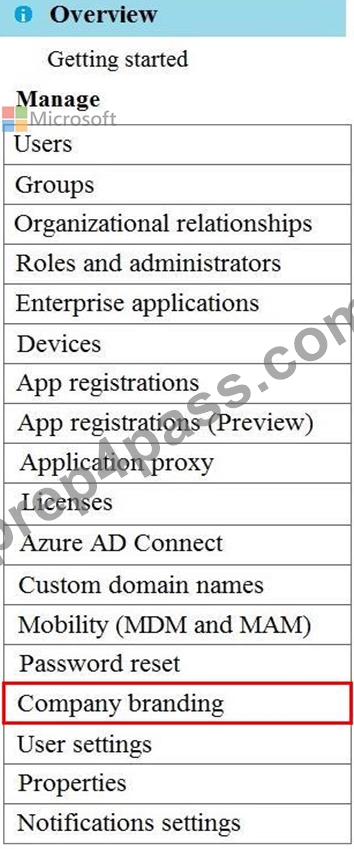
Reference:
https://blogs.msdn.microsoft.com/sgern/2018/10/11/intune-intune-and-autopilot-part-3-preparing-your-environment/
https://blogs.msdn.microsoft.com/sgern/2018/11/27/intune-intune-and-autopilot-part-4-enroll-your-first-device/
NEW QUESTION # 43
You have a Microsoft 365 subscription.
You use Microsoft Intune Suite to manage devices.
You have the iOS app protection policy shown in the following exhibit.
Use the drop-down menus to select the answer choice that completes each statement based on the information presented in the graphic. NOTE: Each correct selection is worth one point,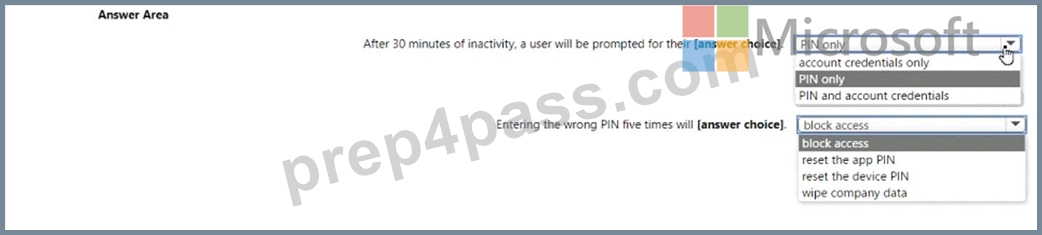
Answer:
Explanation: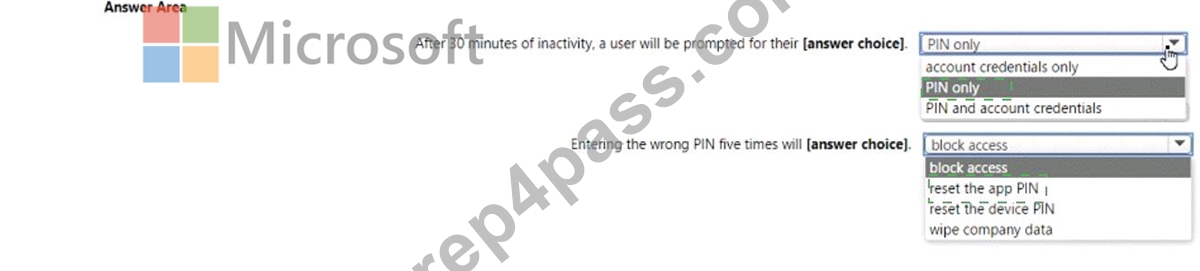
Explanation
Box 1 = PIN only
Box 2 = reset the PIN app
iOS/iPadOS app protection policy settings - Microsoft Intune | Microsoft Learn
https://learn.microsoft.com/en-us/mem/intune/apps/app-protection-policy-settings-ios
NEW QUESTION # 44
You have a Microsoft 365 E5 subscription.
You create an app protection policy for Android devices named Policy1 as shown in the following exhibit.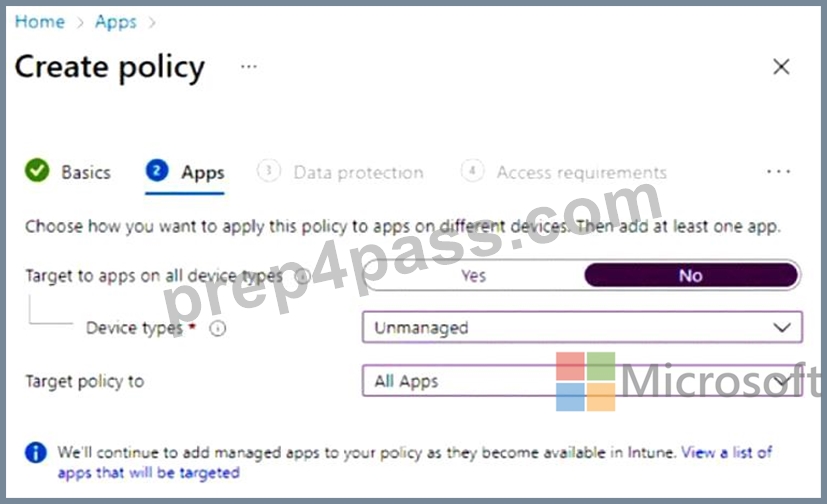
Use the drop-down menus to select the answer choice that completes each statement based on the information presented in the graphic.
NOTE: Each correct selection is worth one point.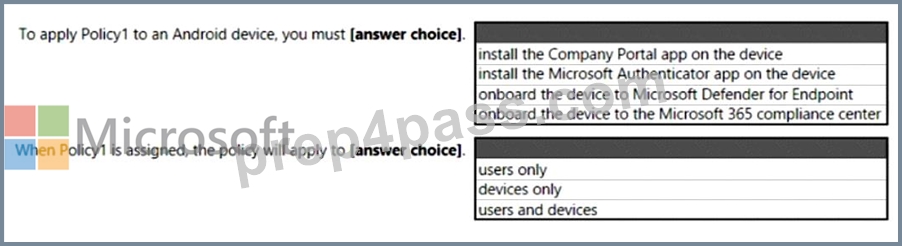
Answer:
Explanation: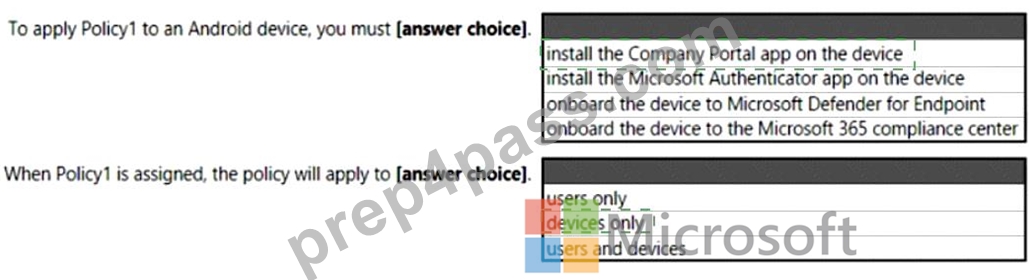
Explanation
Box 1: Install the Intune Company Portal app on the device
On Android, Android devices will prompt to install the Intune Company Portal app regardless of which Device type is chosen.
Bix 2: Devices only
For Android devices, unmanaged devices are devices where Intune MDM management has not been detected.
This includes devices managed by third-party MDM vendors.
Reference:
https://docs.microsoft.com/en-us/mem/intune/apps/app-protection-policies#app-protection-policies-for-iosipados
NEW QUESTION # 45
You have a Microsoft 365 tenant that uses Microsoft Intune to manage personal and corporate devices. The tenant contains three Windows 10 devices as shown in the following exhibit.
How will Intune classify each device after the devices are enrolled in Intune automatically? To answer, select the appropriate options in the answer area.
NOTE: Each correct selection is worth one point.
Answer:
Explanation:
Reference:
https://docs.microsoft.com/en-us/azure/active-directory/devices/concept-azure-ad-join
https://docs.microsoft.com/en-us/azure/active-directory/devices/concept-azure-ad-register
NEW QUESTION # 46
You have a Microsoft 365 subscription that contains a user named User1. User! is assigned a Windows 10/11 Enterprise E3 license. You use Microsoft Intune Suite to manage devices. User1 activates the following devices:
* Device1: Windows 11 Enterprise
* Device2: Windows 10 Enterprise
* Device3: Windows 11 Enterprise
How many more devices can User1 activate?
- A. 0
- B. 1
- C. 2
- D. 3
Answer: B
NEW QUESTION # 47
You need to meet the technical requirements for the new HR department computers.
How should you configure the provisioning package? To answer, select the appropriate options in the answer area.
NOTE: Each correct selection is worth one point.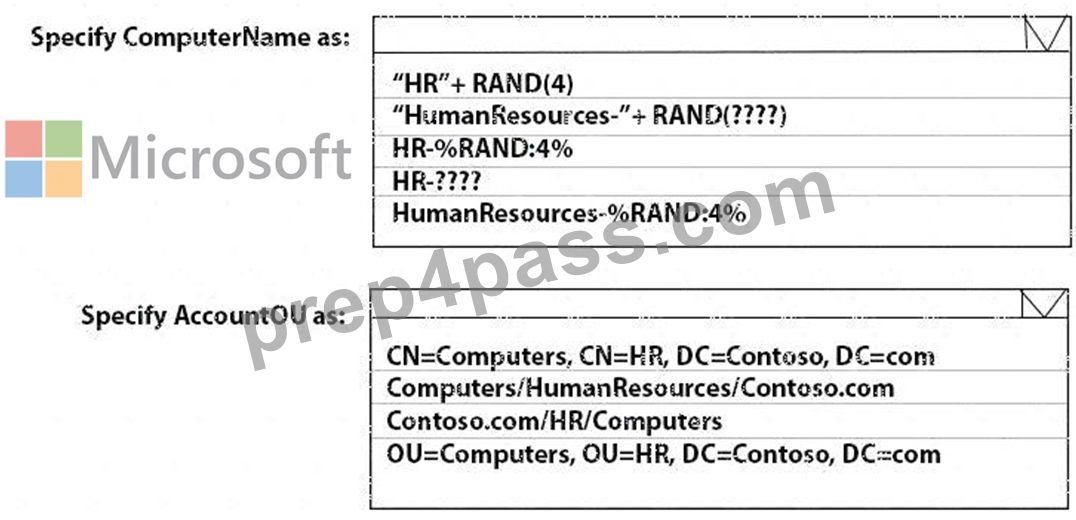
Answer:
Explanation: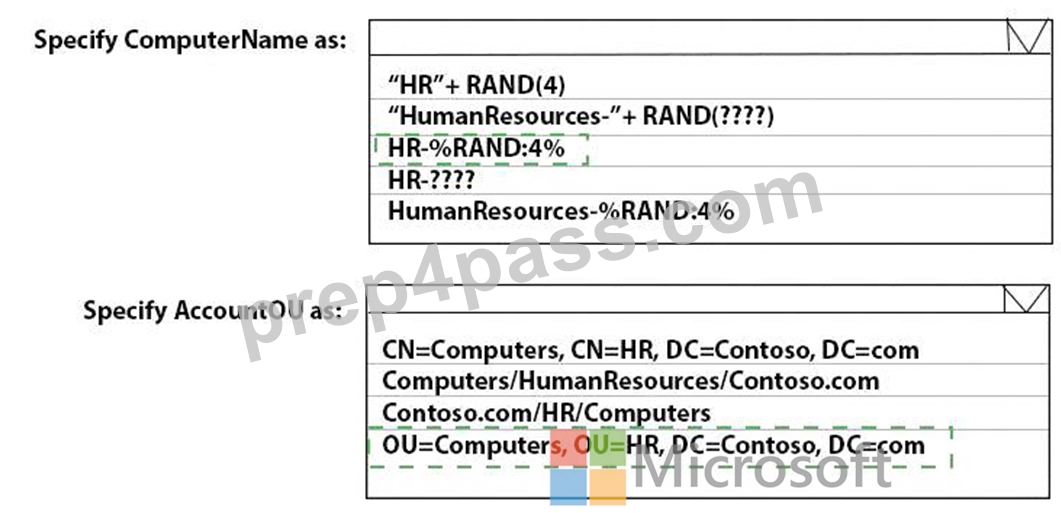
Explanation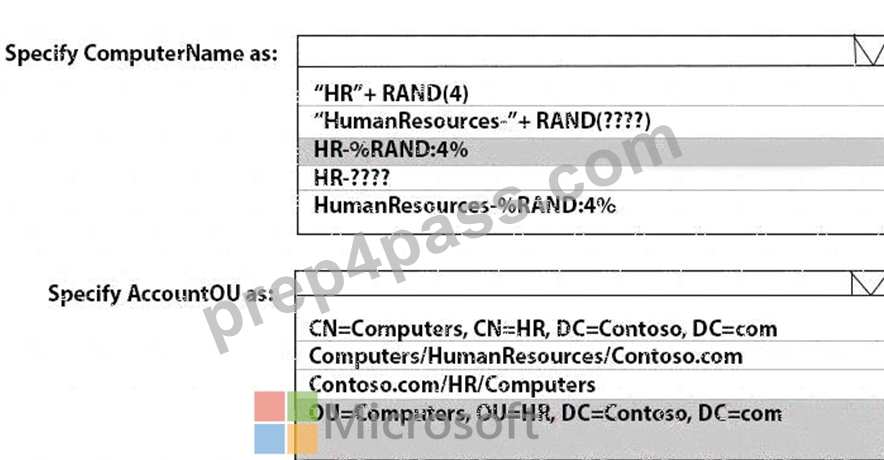
Reference:
https://docs.microsoft.com/en-us/windows/configuration/wcd/wcd-accounts
NEW QUESTION # 48
You have a server named Server1 and computers that run Windows 8.1. Server1 has the Microsoft Deployment Toolkit (MDT) installed.
You plan to upgrade the Windows 8.1 computers to Windows 10 by using the MDT deployment wizard.
You need to create a deployment share on Server1.
What should you do on Server1, and what are the minimum components you should add to the MDT deployment share? To answer, select the appropriate options in the answer area.
NOTE: Each correct selection is worth one point.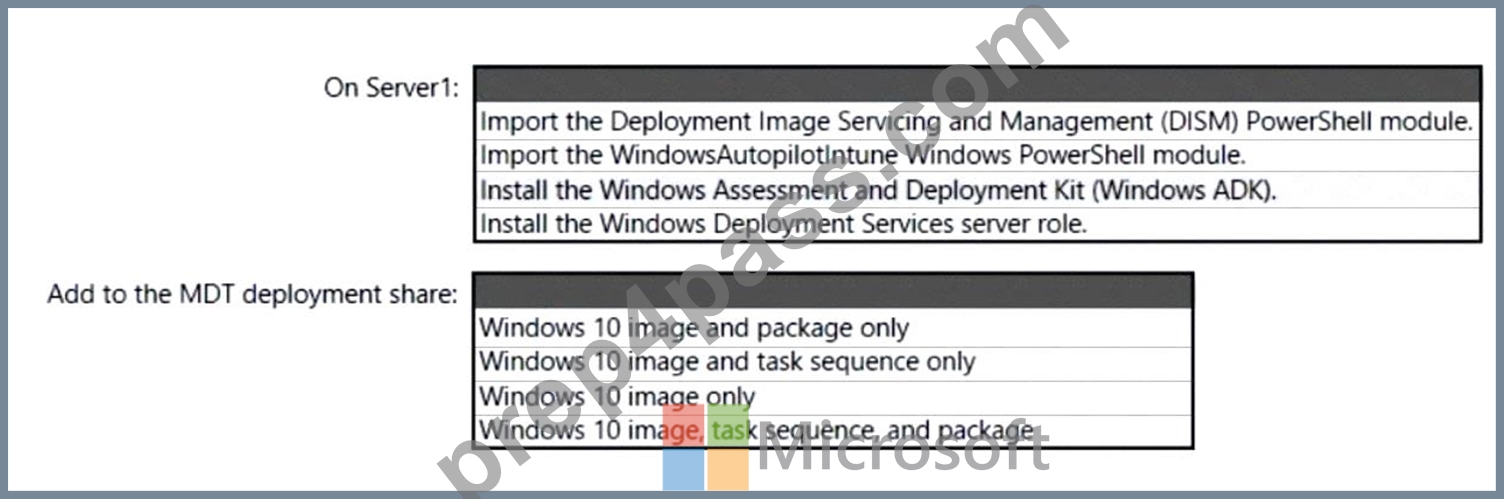
Answer:
Explanation: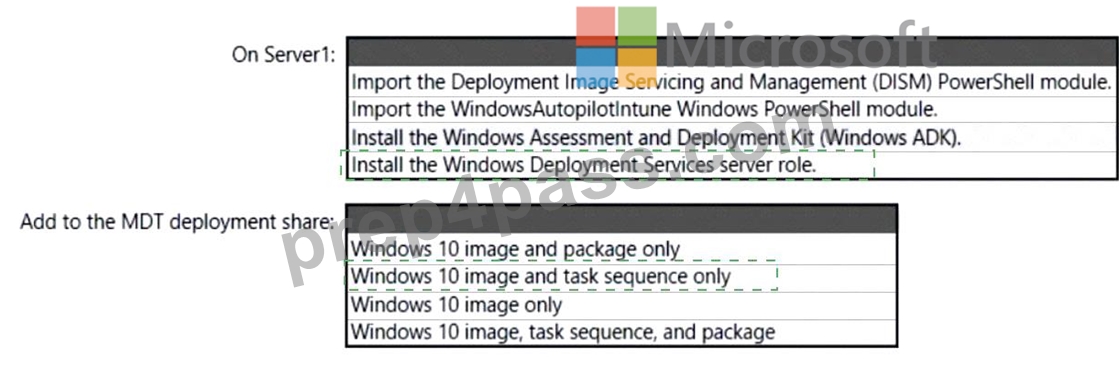
Explanation
Box 1: Install the Windows Deployment Services role.
Install and initialize Windows Deployment Services (WDS)
On the server:
Open an elevated Windows PowerShell prompt and enter the following command:
Install-WindowsFeature -Name WDS -IncludeManagementTools
WDSUTIL /Verbose /Progress /Initialize-Server /Server:MDT01 /RemInst:"D:\RemoteInstall" WDSUTIL /Set-Server /AnswerClients:All Box 2: Windows 10 image and task sequence only Create the reference image task sequence In order to build and capture your Windows 10 reference image for deployment using MDT, you will create a task sequence.
Reference:
https://docs.microsoft.com/en-us/windows/deployment/deploy-windows-mdt/prepare-for-windows-deployment-w
https://docs.microsoft.com/en-us/windows/deployment/deploy-windows-mdt/create-a-windows-10-reference-ima
NEW QUESTION # 49
You use Microsoft Intune and Intune Data Warehouse.
You need to create a device inventory report that includes the data stored in the data warehouse.
What should you use to create the report?
- A. Microsoft Power Bl
- B. the Company Portal app
- C. the Azure portal app
- D. Endpoint analytics
Answer: A
Explanation:
Explanation
You can use the Power BI Compliance app to load interactive, dynamically generated reports for your Intune tenant. Additionally, you can load your tenant data in Power BI using the OData link. Intune provides connection settings to your tenant so that you can view the following sample reports and charts related to:
Devices
Enrollment
App protection policy
Compliance policy
Device configuration profiles
Software updates
Device inventory logs
Note: Load the data in Power BI using the OData link
With a client authenticated to Azure AD, the OData URL connects to the RESTful endpoint in the Data Warehouse API that exposes the data model to your reporting client. Follow these instructions to use Power BI Desktop to connect and create your own reports.
Sign in to the Microsoft Endpoint Manager admin center.
Select Reports > Intune Data warehouse > Data warehouse.
Retrieve the custom feed URL from the reporting blade, for example:
https://fef.{yourtenant}.manage.microsoft.com/ReportingService/DataWarehouseFEService/dates?api-ver Open Power BI Desktop.
Choose File > Get Data. Select OData feed.
Choose Basic.
Type or paste the OData URL into the URL box.
Select OK.
If you have not authenticated to Azure AD for your tenant from the Power BI desktop client, type your credentials. To gain access to your data, you must authorize with Azure Active Directory (Azure AD) using OAuth 2.0.
Select Organizational account.
Type your username and password.
Select Sign In.
Select Connect.
Select Load.
Reference: https://docs.microsoft.com/en-us/mem/intune/developer/reports-proc-get-a-link-powerbi
NEW QUESTION # 50
You use a Microsoft Intune subscription to manage iOS devices.
You configure a device compliance policy that blocks jailbroken iOS devices.
You need to enable Enhanced jailbreak detection.
What should you configure?
- A. the device compliance policy
- B. a configuration profile
- C. the Compliance policy settings
- D. a network location
Answer: B
NEW QUESTION # 51
......
Microsoft MD-102 Exam Syllabus Topics:
| Topic | Details |
|---|---|
| Topic 1 |
|
| Topic 2 |
|
| Topic 3 |
|
| Topic 4 |
|
| Topic 5 |
|
| Topic 6 |
|
| Topic 7 |
|
| Topic 8 |
|
| Topic 9 |
|
| Topic 10 |
|
| Topic 11 |
|
MD-102 Dumps Ensure Your Passing: https://passguide.prep4pass.com/MD-102_exam-braindumps.html
