

Practice CIMAPRA19-F03-1 Questions With Certification guide Q&A from Training Expert Prep4pass
Free CIMA CIMAPRA19-F03-1 Test Practice Test Questions Exam Dumps
The CIMA CIMAPRA19-F03-1 exam also covers risk management. Risk management within organizations is a continuous process whereby companies aim to identify, evaluate, and manage potential risk areas to minimize their impact on the business as a whole. For this reason, the exam covers factors such as identifying different types of risks, evaluating the likelihood and impact of those risks, and developing strategies to minimize those risks.
Topics of the CIMA F3: Financial Strategy Exam
CIMA F3 exam dumps included the following topics:
- Financial policy decisions 15%
- Sources of long-term funds 25%
- Financial risks 20%
- Business valuation 40%
To prepare for the CIMA F3 Exam, candidates are advised to study the CIMA syllabus, watch video lectures, and practice past exam papers. CIMAPRA19-F03-1 exam is computer-based and available year-round, so candidates can choose the best time to take the exam that suits them. Passing the CIMA F3 Exam is a critical step towards becoming a qualified management accountant and opens up a wide range of career opportunities in finance and accounting.
NEW QUESTION # 209
Which of the following statements about the tax impact on debt finance is correct?
- A. Debt instruments issued with fixed and floating charges do not attract tax relief on interest paid.
- B. Preference share dividends attract tax relief in the same way as debenture interest.
- C. Interest on debt is deducted from post-tax profits.
- D. Interest on debt is deducted from pre-tax profits.
Answer: D
NEW QUESTION # 210
Company B is an all equity financed company with a cost of equity of 10%.
It is considering issuing bonds in order to achieve a gearing level of 20% debt and 80% equity.
These bonds will pay a coupon rate of 5% and have an interest yield of 6%.
Company B pays corporate tax at the rate of 25%.
According to Modigliani and Miller's theory of capital structure with tax, what will be Company B's new cost of equity?
- A.

- B.

- C.

- D.

Answer: C
Explanation:
BHere's why:Current (ungeared) cost of equity, ku=10%k_u = 10\%ku=10%Target gearing: 20% debt, 80% equity #DE=2080=0.25\frac{D}{E} = \frac{20}{80} = 0.25ED=8020=0.25 Corporate tax rate, T=25%#(1#T)
=0.75T = 25\% \Rightarrow (1 - T) = 0.75T=25%#(1#T)=0.75Relevant cost of debt is the interest yield, 6% (not the 5% coupon), so kd=6%k_d = 6\%kd=6%Under Modigliani & Miller with tax, the cost of equity for a geared firm is:ke=ku+(ku#kd)(1#T)DEk_e = k_u + (k_u - k_d)(1 - T)\frac{D}{E}ke=ku+(ku#kd)(1#T)ED Substitute the numbers:ke=10%+(10%#6%)×0.75×0.25k_e = 10\% + (10\% - 6\%) \times 0.75 \times 0.25 ke=10%+(10%#6%)×0.75×0.25 ke=10%+4%×0.1875k_e = 10\% + 4\% \times 0.1875ke=10%+4%×0.1875
4%×0.1875=0.75%4\% \times 0.1875 = 0.75\%4%×0.1875=0.75% ke=10%+0.75%=10.75%k_e = 10\% +
0.75\% = 10.75\%ke=10%+0.75%=10.75% That matches the expression in Option B:10.75%=10%+[(10%
#6%)×(15/80)]10.75\% = 10\% + [(10\% - 6\%) \times (15/80)]10.75%=10%+[(10%#6%)×(15/80)] (Since 15
/80=0.1875=(1#T)×D/E15/80 = 0.1875 = (1-T)\times D/E15/80=0.1875=(1#T)×D/E)#
NEW QUESTION # 211
Company ACC. an ungeared car manufacturer has launched a takeover bid of Company BDD. a key competitor operating in the same industry Company BDD has high gearing Company ACC has a large surplus cash balance and believes that the acquisition is an opportunity to enhance shareholder wealth through the realisation of synergistic benefits. Which THREE of the following would most likely be synergistic benefits to Company ACC of purchasing Company BDD9 I
- A. Reduction in staff costs due to the removal of duplicated roles.
- B. Cost savings in production due to economies of scale
- C. Reduction in financial risk due to diversification
- D. Enhanced profit due to reduced competition
- E. Decreased cost of debt
Answer: A,B,E
NEW QUESTION # 212
On 1 January 20X1, a company had:
* Cost of equity of 10 0%.
* Cost of debt of 5.0%
* Debt of $100Mmilion
* 100 million $1 shares trading at $4.00 each.
On 1 February 20X1:
* The company's share police fell to $3.00.
* Debt and the cost of debt remained unchanged
The company does not pay tax.
Under Modigliani and Miller's theory without lax. what is the best estimate of the movement in the cost of equity as a result of the fall in ne share price?
- A. It will rise to 10.3%.
- B. It will stay the same at 10.0%.
- C. It will rise to 11.2%.
- D. It will fall to 9.3%.
Answer: B
Explanation:
At 1 Jan:
Cost of equity, ke=10%k_e = 10\%ke=10%
Cost of debt, kd=5%k_d = 5\%kd=5%
Debt D=100D = 100D=100
Shares = 100m @ $4 # Equity E0=400E_0 = 400E0=400
Total value V0=D+E0=500V_0 = D + E_0 = 500V0=D+E0=500.
WACC under Modigliani & Miller (no tax):
k0=E0V0ke+DV0kd=400500#10%+100500#5%=8%+1%=9%k_0 = \frac{E_0}{V_0}k_e + \frac{D}{V_0} k_d = \frac{400}{500} \cdot 10\% + \frac{100}{500} \cdot 5\% = 8\% + 1\% = 9\% k0=V0E0ke+V0Dkd=500400#10%+500100#5%=8%+1%=9% k0k_0k0 stays constant.
After the share price falls to $3:
Equity E1=100m×3=300E_1 = 100m \times 3 = 300E1=100m×3=300
Debt still 100 # D/E1=100/300=0.3333D/E_1 = 100/300 = 0.3333D/E1=100/300=0.3333 MM no-tax formula:
ke=k0+(k0#kd)DE=9%+(9%#5%)#100300=9%+4%#0.3333#9%+1.33%=10.33%k_e = k_0 + (k_0 - k_d)\frac
{D}{E} = 9\% + (9\% - 5\%) \cdot \frac{100}{300} = 9\% + 4\% \cdot 0.3333 \approx 9\% + 1.33\% = 10.33
\%ke=k0+(k0#kd)ED=9%+(9%#5%)#300100=9%+4%#0.3333#9%+1.33%=10.33%
Rounded # 10.3%.
NEW QUESTION # 213
The directors of a multinational group have decided to sell off a loss-making subsidiary and are considering the following methods of divestment:
1. Trade sale to an external buyer
2. A management buyout (MBO)
The MBO team and the external buyer have both offered the same price to the parent company for the subsidiary.
Which of the following is an advantage to the parent company of opting for a MBO compared to a trade sale as the preferred method of divestment?
- A. Avoid a hostile reaction from key management.
- B. Retain the know edge of key management.
- C. Focus on the core competencies of the business
- D. Raise the cash more quickly.
Answer: A
NEW QUESTION # 214
A company wishes to raise new finance using a rights issue to invest in a new project offering an IRR of 10% The following data applies:
* There are currently 1 million shares in issue at a current market value of $4 each.
* The terms of the rights issue will be $3.50 for 1 new share for 5 existing shares.
* The company's WACC is currently 8%.
What is the yield-adjusted theoretical ex-rights price (TERP)?
Give your answer to 2 decimal places.
$ ?
Answer:
Explanation:
4.06, 4.060
NEW QUESTION # 215
A company is financed by debt and equity and pays corporate income tax at 20%.
Its main objective is the maximisation of shareholder wealth.
It needs to raise $200 million to undertake a project with a positive NPV of $10 million.
The company is considering three options:
* A rights issue.
* A bond issue.
* A combination of both at the current debt to equity ratio.
Estimations of the market values of debt and equity both before and after the adoption of the project have been calculated, based upon Modigliani and Miller's capital theory with tax, and are shown below: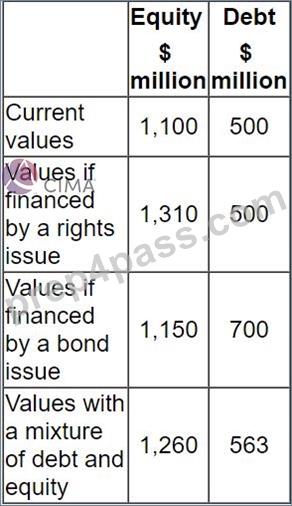
Under Modigliani and Miller's capital theory with tax, what is the increase in shareholder wealth?
- A. $10 million irrespective of finance
- B. $160 million if financed by a mixture of debt and equity
- C. $210 million if financed by equity
- D. $50 million if financed by debt
Answer: D
NEW QUESTION # 216
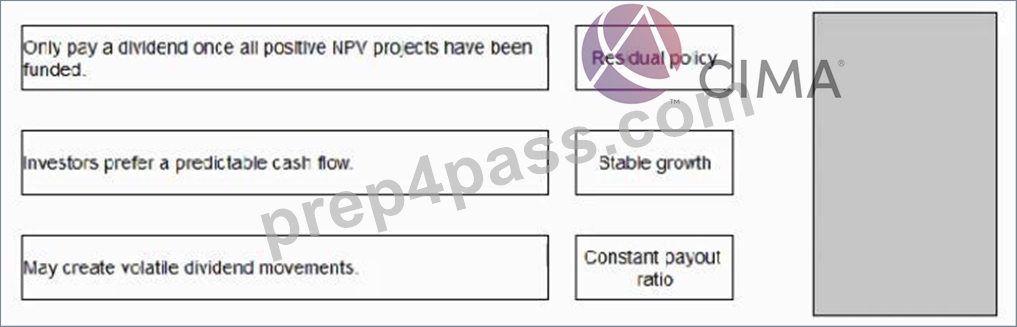
Select the most appropriate divided for each of the following statements: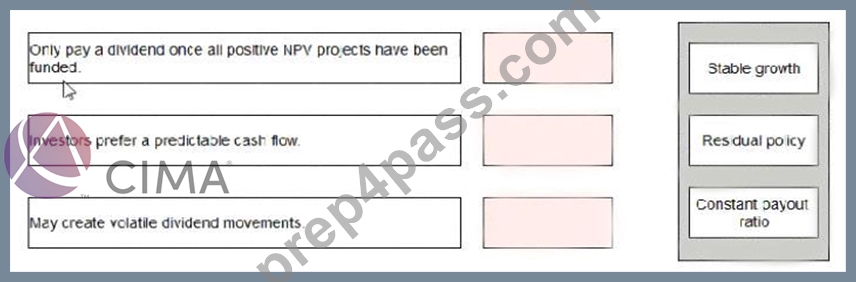
Answer:
Explanation: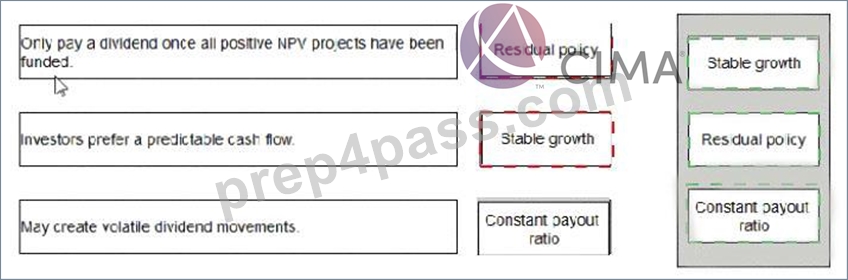
NEW QUESTION # 217
Under traditional theory, an increase in a company's WACC would cause the value of the company to:
- A. Stay the same
- B. Decrease
- C. Either increase or decrease
- D. Increase
Answer: B
NEW QUESTION # 218
D has US$10 million to invest over 12 months in either USS or GBP Its options are to invest in USS at the present USS interest rate of 10 18%. or to convert the USS to GBP at the spot rate GBP1 =US$1 61 and invest in GBP at an interest rate of 6.4%.
According to the interest rate parity theory, what will the one year forward rate be?
Give your answer to three decimal places.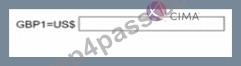
Answer:
Explanation:
1.667
NEW QUESTION # 219
RST wishes to raise at least $40 million of new equity by issuing up to 10 million new equity shares at a minimum price of $3.00 under an offer for sale by tender. It receives the following tender offers: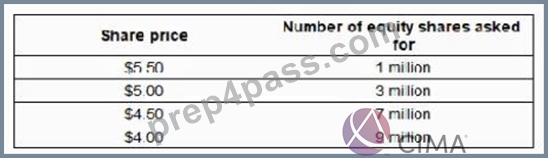
What is the maximum amount that RST can raise by this share issue?
(Give your answer to the nearest $ million).
Answer:
Explanation:
49
NEW QUESTION # 220
A listed company plans to raise new capital which will be required for future investment projects. The company has a gearing ratio of 50%, which is just below the company's target ratio.
The directors are comparing the benefits and drawbacks of each of the following two alternative sources of finance;
* Unsecured bank borrowings.
* Convertible bonds.
Which of the following statements is correct?
- A. Additional finance will be raised upon conversion of the convertible bond but not with unsecured borrowings.
- B. If the convertible bond holders eventually convert to shares the company's gearing ratio will rise whereas it will be unaffected if finance is with unsecured borrowings.
- C. The coupon rate of a convertible bond is likely to be lower than for unsecured borrowings.
- D. If the share price does not increase sufficiently for conversion to take place the company will have more expensive debt with a convertible bond than with unsecured borrowings.
Answer: A
NEW QUESTION # 221
Which THREE of the following would be of most interest to lenders deciding whether to provide long-term debt to a company?
- A. interest cover on existing debt
- B. Quality of current management
- C. Earnings per share
- D. Current gearing ratio
- E. Dividend cover
Answer: A,B,D
NEW QUESTION # 222
On 1 January:
* Company X has a value of $50 million
* Company Y has a value of $20 million
* Both companies are wholly equity financed
Company X plans to take over Company Y by means of a share exchange. Following the acquisition the post- tax cashflow of Company X for the foreseeable future is estimated to be $8 million each year. The post- acquisition cost of equity is expected to be 10%.
What is the best estimate of the value of the synergy that would arise from the acquisition?
- A. $100 million
- B. $60 million
- C. $10 million
- D. $30 million
Answer: C
Explanation:
Post-acquisition, Company X's annual post-tax cash flow = 8m in perpetuity.
Cost of equity = 10%.
Combined value after acquisition:
Vcombined=80.10=80 millionV_{\text{combined}} = \frac{8}{0.10} = 80\ \text{million}Vcombined=0.
108=80 million
Pre-acquisition total value:
VX+VY=50+20=70 millionV_X + V_Y = 50 + 20 = 70\ \text{million}VX+VY=50+20=70 million Synergy value:
Synergy=80#70=10 million\text{Synergy} = 80 - 70 = 10\ \text{million}Synergy=80#70=10 million
NEW QUESTION # 223
Company T has 1,000 million shares in issue with a current share price of $10 each.
Company V has 300 million shares in issue with a current share price of $5 each.
Company T is considering acquiring Company V.
Total synergy gains of $100 million have been estimated.
The purchase of Company V's shares would be by cash at a 10% premium above the current share price.
In seeking approval for the acquisition, the likely reaction from T's shareholders will be:
- A. rejected as T's shareholders will see a decrease in their wealth overall of $50 million.
- B. rejected as T's shareholders will not be willing to pay more than $1,500 million for V.
- C. accepted as there will be an increase in the value of the business of $1,500 million.
- D. accepted as there is $100 million of synergy which will all go to T's shareholders.
Answer: A
Explanation:
Value of V currently = 300m × $5 = $1,500m
Offer price = $5 × 1.10 = $5.50 # cost = 300m × 5.50 = $1,650m
Synergy = $100m
Net gain to T's shareholders = 100 # 150 = -$50m # a loss of $50m, so they'd reject.
NEW QUESTION # 224
Company J is in negotiations to acquire Company K and believes it can turn around Company K's performance to match its own.
The following information is available for the two companies: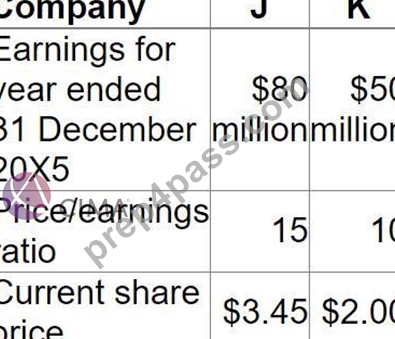
Select the maximum price for each share that Company J should place on Company K during negotiations.
- A. $3.0
- B. $3.2
- C. $1.7
- D. $2.0
Answer: A
NEW QUESTION # 225
In the context of the Integrated Reporting <IR=> Framework which THREE of the following statements are correct?
- A. Sustainability reporting is an intrinsic component of an integrated report
- B. The primary purpose of an integrated report is to ensure that management take environmental issues into consideration when making decisions.
- C. The primary purpose of an integrated report is to explain to providers of financial capital how an entity creates value over time.
- D. An integrated report integrates economic, environmental and social reports and is issued alongside the annual financial statements.
- E. Under integrated reporting 'natural capital' refers to the renewable and non-renewable resources and processes which provide goods or services that support the organisation in the conduct of its business.
Answer: A,C,E
NEW QUESTION # 226
A company has a covenant on its 5% long term corporate bond.
* Covenant - The earnings must not fall below $7 million
The bond has a nominal value of $60 million.
It is currently trading at 80% of its nominal value.
The projected earnings before interest and taxation for next year are $11.5 million.
The company retains 80% of its earnings. It pays tax at 20%.
Advise the Board of Directors which of the following covenant conditions will apply next year?
- A. The earnings will be = $11.50 million (The covenant will not be breached).
- B. The earnings will be = $6.80 million (The covenant will be breached).
- C. The earnings will be = $7.28 million (The covenant will not be breached).
- D. The earnings will be = $5.44 million (The covenant will be breached).
Answer: B
NEW QUESTION # 227
A company is considering either exporting its product directly to customers in a foreign country or establishing a manufacturing subsidiary in that country.
The corporate tax rate in the company's own country is 20% and 25% tax depreciation allowances are available.
Which THREE of the following would be considered advantages of establishing the subsidiary in the foreign country?
- A. Year 1 tax depreciation allowances of 100% are available in the foreign country.
- B. There are high customs duties payable on products entering the foreign country.
- C. The corporate tax rate in the foreign country is 40%.
- D. There is a double tax treaty between the company's domestic country and the foreign country.
- E. There are restrictions on companies wishing to remit profit from the foreign country.
Answer: A,B,D
Explanation:
Consider each statement:
A). Foreign tax rate 40% - higher than home 20% # disadvantage.
B). Double tax treaty - avoids double taxation on profits remitted # advantage.
C). 100% Year-1 tax depreciation in foreign country - big early tax shield # advantage.
D). High customs duties on imports into foreign country - makes exporting costly; local production via subsidiary avoids duties # advantage.
E). Restrictions on remitting profits - makes getting cash out difficult # disadvantage.
NEW QUESTION # 228
A listed entertainment and media company produces and distributes films globally. The company invests heavily in intellectual property in order to create the scope for future film projects. The company has five separate distribution companies, each managed as a separate business unit The company is seeking to sell one of its business units in a management buy-out (MBO) to enable it to raise finance for proposed new investments The business unit managers have been in discussions with a bank and venture capitalists regarding the financing for the MBO The venture capitalists are only prepared to invest a mixture of debt and equity and have suggested the following:
The venture capitalists have stated that they expect a minimum return on their equity investment of 30% a year on a compound basis over the first 5 years of the MBO No dividends will be paid during this period.
Advise the MBO team of the total amount due to the venture capitalist over the 5-year period to satisfy their total minimum return?
- A. $120 14 million
- B. $111 39 million
- C. $155.14 million
- D. $146 39 million
Answer: B
NEW QUESTION # 229
Company A is planning to acquire Company B. Both companies are listed and are of similar size based on market capitalisation No approach has yet been made to Company B's shareholders as the directors of Company A are undecided about the most suitable method of financing the offer Two methods are under consideration a share exchange or a cash offer financed by debt.
Company A currently has a gearing ratio (debt to debt plus equity) of 30% based on market values. The average gearing ratio (debt to debt plus equity) for the industry is 50% Although no formal offer has been made there have been market rumours of the proposed bid. which is seen as favorable to Company A. As a consequence. Company As share price has risen over the past few weeks while Company B's share price has fallen.
Which THREE of the following statements are most likely to be correct?
- A. The method of finance chosen will not affect the post-acquisition earning per share of the combined business
- B. Company B's shareholders will be able to participate in the future growth of the combined business if it is a share exchange
- C. Based on current share price movements, a share exchange would mean Company A has to issue fewer shares to acquire Company B than it would have done a few weeks ago
- D. Company A's weighted average cost of capital will fall if financing is with debt
- E. Company A's gearing will increase following a share exchange.
Answer: B,C,D
Explanation:
A and B similar market cap.
A's gearing (D / (D+E)) = 30% vs industry 50% # relatively under-geared.
Rumours of bid good for A (A share price up) and bad for B (B share price down).
Financing choices: share exchange or cash raised by new debt.
Assess statements:
A). A's price # and B's price #. For a given value per B share, fewer A shares are now needed than a few weeks ago # True.
B). With a share exchange, B's shareholders receive A's shares, so they share in future performance of combined entity # True.
C). Financing method does affect EPS (interest expense vs number of shares) # False.
D). Under MM with tax and given A is under-geared vs the 50% industry norm, adding debt is likely to lower WACC via the tax shield (ignoring distress costs) # Most likely true.
E). A share exchange issues equity, not debt; gearing effect is ambiguous and not necessarily an increase # Not "most likely".
NEW QUESTION # 230
An unlisted company has the following data: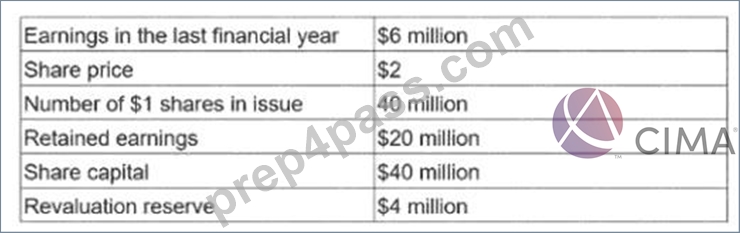
A listed company in the same industry has a P/E of 11.
The value of the unlisted company based on the P/E of this listed company is:
Give your answer to the nearest whole number.
Answer:
Explanation:
$66 million
Explanation:
This question applies the Price/Earnings (P/E) valuation method, which is covered in CIMA F3 under Business Valuation and Market-Based Valuation Techniques. The P/E method is commonly used to value unlisted companies by reference to a comparable listed company operating in the same industry, provided that earnings are representative and sustainable.
Under CIMA F3 guidance, when using a P/E multiple:
* The earnings figure used should be the most recent maintainable earnings.
* The P/E ratio should be taken from a listed comparator with similar business risk.
* The valuation focuses on equity value, not enterprise value.
In this scenario, the unlisted company reported earnings of $6 million in the last financial year. A listed company in the same industry has a P/E ratio of 11, which is assumed to appropriately reflect market expectations regarding growth and risk for businesses in this sector.
The valuation is therefore calculated as follows:
This gives an estimated equity value of $66 million.
It is important to note, in line with CIMA F3 principles, that balance sheet items such as retained earnings, share capital, and revaluation reserves are not directly relevant to a P/E-based valuation. The P/E approach is an income-based valuation method, relying solely on earnings and market multiples, rather than book values.
Rounding to the nearest whole number, as required by the question, confirms the final valuation.
NEW QUESTION # 231
A company intends to sell one of its business units. Company W, by a management buyout (MBO). A selling price of S200 million has been agreed.
The managers are discussing with a bank and a venture capital company (VCC) the following financing proposal.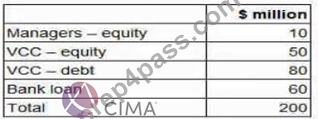
The VCC requires a minimum return on its equity investment In the MBO of 35% a year on a compound basis over 5 years What is the minimum total equity value of Company W in 5 years time in order to meet the VCC's required return? Give your answer to one decimal place.
Answer:
Explanation:
65
NEW QUESTION # 232
Company BBB has prepared a valuation of a competitor company, Company BBD. Company BBB is intending to acquire a controlling interest in the equity of Company BBD and therefore wants to value only the equity of Company BBD.
The directors of Company BBB have prepared the following valuation of Company BBD:
Value of Equity = 4.63 + 5.14 + 5.56 = S15.33 million
Additional information on Company BBD:
Which THREE of the following are weaknesses of the above valuation?
- A. The approach used calculates the value of the total entity not the value of equity.
- B. Free cash flows to all investors should be discounted at the cost of equity of 10% rather than WACC of 8%.
- C. The valuation is understated as forecast future growth has been ignored beyond year 3.
- D. The valuation is overstated as the directors have failed to deduct tax from the free cash flows.
- E. The valuation is understated as the directors have failed to include a perpetuity factor in the calculations.
Answer: A,D,E
NEW QUESTION # 233
Company ABD and Company BCD operate in the same industry and each has a significant market share.
The directors of Company ABD have heard rumours in the market that Company BCD is planning to bid to takeover Company ABD. They do not believe the takeover would be in the best interests of the shareholders and are therefore keen to prevent the bid from going ahead.
Which THREE of the following defense strategies could be used by the directors of Company ABD at this point in time?
- A. Communicate effectively with their shareholders
- B. Refer the bid to the competition authorities
- C. Poison Pill
- D. White Knight
- E. Revalue the non-current assets
Answer: A,C,E
Explanation:
At the rumour stage (pre-bid), suitable defences are pre-emptive ones:
A - Communicate effectively with shareholders: build support and explain strategy to keep the share price fair and reduce vulnerability.
B - Revalue non-current assets: helps ensure the shares are not undervalued and makes any bid look less attractive.
D - Poison pill: introduce mechanisms (e.g. rights issues to existing shareholders) that make a hostile bid very costly.
C (competition authorities) and E (white knight) are reactive and typically used only once an actual bid has been made.
NEW QUESTION # 234
......
Prepare Top CIMA CIMAPRA19-F03-1 Exam Audio Study Guide Practice Questions Edition: https://passguide.prep4pass.com/CIMAPRA19-F03-1_exam-braindumps.html
