

Latest Swift CSP-Assessor Practice Test Questions, Swift Customer Security Programme Assessor Certification Exam Dumps
Aug-2026 Pass Swift CSP-Assessor Exam in First Attempt Easily
NEW QUESTION # 35
Can an assessor re-use an ISAE 3000 report dating back 2 years to support an independent assessment?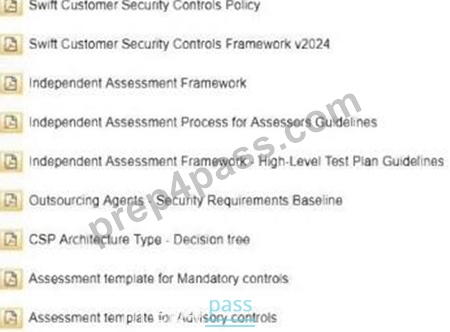
- A. No, the SAE 3000 report is no valid surrogate as a rule
- B. Yes, provided there is no change to the Swift user's infrastructure
- C. No, that is too old, the maximum is 18 months
- D. Yes, there is no time limit for an iSAE 3000 report
Answer: C
NEW QUESTION # 36
Using the outsourcing agent diagram. Which components must be placed in a secure zone? (Choose all that apply.)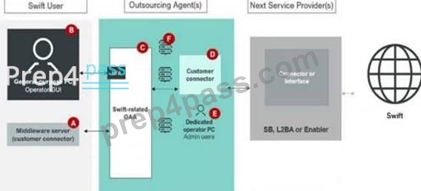
- A. Component B
- B. Component D
- C. Component A
- D. Component C
Answer: B,C
NEW QUESTION # 37
Select the supporting documents to conduct a CSP assessment. (Choose all that apply.)
- A. The CSP User Handbook
- B. The Customer Security Controls Framework
- C. The mapping to industry standards article
- D. The Controls Matrix and High Level Test P an
Answer: B
NEW QUESTION # 38
The messaging operator in Alliance Lite2... (Select the two correct answers that apply)
*Connectivity
*Generic
*Products Cloud
*Products OnPrem
*Security
- A. Can assign RBAC roles to RMA operators and messaging operators
- B. Can create and modify messages
- C. Can approve the Customer Security Officer change requests
- D. Can approve messages
Answer: B,D
NEW QUESTION # 39
Which authentication methods are possible on the Alliance Interfaces? (Choose all that apply.)
- A. LDAP Authentication
- B. Password and TOTP
- C. Radius One-time password
- D. Password
Answer: A,B,C,D
NEW QUESTION # 40
As a Swift CSP Certified Assessor. Swift contacted me to provide evidence on an assessment I have performed. This is required to support their quality assurance validation process. Is it allowed?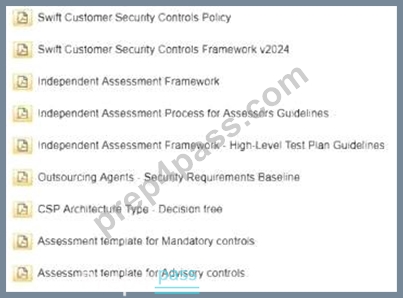
- A. Yes, one of the obligations of the certification programme is that quality assessment can be performed by Swift
- B. No, it's confidential
Answer: A
Explanation:
This question addresses the obligations of a Swift CSP Certified Assessor regarding the provision of evidence to Swift for quality assurance purposes.
Step 1: Understand the Role of a Swift CSP Certified Assessor
A Swift CSP Certified Assessor is an independent professional or entity authorized to conduct CSP assessments under theIndependent Assessment Framework. The certification program, managed by Swift, includes specific obligations to ensure the integrity and quality of assessments.
Step 2: Analyze the Request for Evidence
* Swift has contacted the assessor to provide evidence from an assessment to support their quality assurance validation process. This request implies a review of the assessor's work to ensure compliance with CSP standards.
* TheSwift CSP Assessor Certification Program Guidelinesstate that certified assessors are obligated to cooperate with Swift's quality assurance processes. This includes providingevidence (e.g., assessment reports, workpapers) upon request to verify the accuracy and adherence to methodology, as part of Swift's oversight.
* Confidentiality is a concern, but theCSCF v2024andAssessor Certification Programclarify that assessors must share evidence with Swift under a non-disclosure agreement (NDA) or similar confidentiality framework, ensuring data protection while allowing validation.
Step 3: Evaluate Each Option
* A. Yes, one of the obligations of the certification programme is that quality assessment can be performed by SwiftTheSwift CSP Assessor Certification Program Guidelinesexplicitly outline that Swift may conduct quality assessments, and assessors must provide evidence to support this process.
This is a contractual obligation of certification, aligning with Swift's responsibility to maintain CSP integrity.Conclusion: This is correct.
* B. No, it's confidentialWhile confidentiality is critical (protected underControl 2.3: System Access Controland Swift's privacy policies), the certification program requires assessors to share evidence with Swift for quality assurance, subject to confidentiality agreements. Refusing to provide evidence would breach the assessor's obligations.Conclusion: This is incorrect.
Step 4: Conclusion and Verification
The answer isA, as theSwift CSP Assessor Certification Programmandates that certified assessors must support Swift's quality assurance validation by providing evidence, balancing confidentiality with compliance oversight.
References
* Swift Customer Security Controls Framework (CSCF) v2024, Control 2.3: System Access Control.
* Swift CSP Assessor Certification Program Guidelines, Section: Obligations and Quality Assurance.
* Swift Independent Assessment Framework, Section: Assessor Responsibilities.
NEW QUESTION # 41
In the illustration, identify which components are in scope of the CSCF? (Choose all that apply.)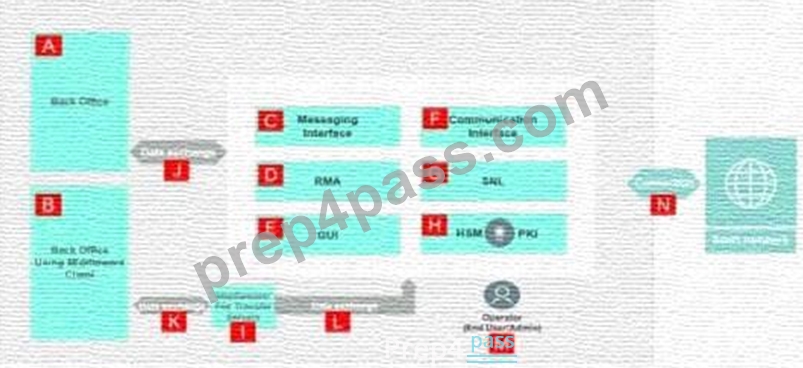
- A. Components C, E, M
- B. Components F, G, H
- C. Components A, B, K
- D. Components J, K, I
Answer: A,B
Explanation:
The Swift Customer Security Controls Framework (CSCF) defines the scope of components that must comply with its security controls. This scope is detailed in theCSCF v2024(and prior versions like CSCF v2023), which specifies that the CSCF applies to systems directly involved in the Swift messaging and connectivity ecosystem. Let's analyze the diagram to identify which components fall within this scope.
Step 1: Understand the Scope of CSCF
According to theSwift Customer Security Controls Framework (CSCF) v2024, the scope includes:
* Swift messaging interfaces(e.g., Alliance Access/Entry, RMA).
* Communication interfacesto the Swift network (e.g., SNL, HSM, PKI).
* Operator systemsdirectly interacting with Swift components (e.g., GUIs, admin/operator workstations).
* Middlewareor connectors directly facilitating Swift message flows.Systems that are not directly involved in Swift messaging or connectivity (e.g., back-office systems, general-purpose servers) are typically out of scope unless they pose a direct risk to the Swift environment.
Step 2: Analyze the Diagram and Identify Components
The diagram includes the following labeled components:
* A. Back Office: A system for back-office operations, not directly part of Swift messaging.
* B. Back Office Using Middleware Client: A back-office system with middleware for data exchange.
* C. Messaging Interface: Likely a Swift messaging interface (e.g., Alliance Access).
* D. RMA: Relationship Management Application, a Swift component for managing messaging relationships.
* E. GUI: Graphical User Interface for operators to interact with the messaging interface.
* F. Communication Interface: Interface for connecting to the Swift network.
* G. SNL: SwiftNet Link, a communication layer for Swift connectivity.
* H. HSM & PKI: Hardware Security Module and Public Key Infrastructure, used for secure Swift connectivity.
* I. Middleware File Transfer Servers: Servers facilitating data exchange between back-office and Swift systems.
* J, K, L. Data Exchange Paths: Represent data flows between systems (not components themselves).
* M. Operator (End User): The operator's workstation interacting with the Swift GUI.
* N. Connector: The connection point to the Swift network.
Step 3: Evaluate Each Option Against CSCF Scope
* A. Components A, B, K
* A (Back Office): Back-office systems are not in scope unless they directly process Swift messages. The CSCF focuses on Swift-specific infrastructure, and back-office systems are typically considered out of scope unless they pose a direct risk (e.g., via middleware).
* B (Back Office Using Middleware Client): While this system uses middleware to exchange data with Swift components, it is still a back-office system, not a core Swift component. The middleware itself (I) may be in scope, but the client (B) is not.
* K (Data Exchange Path): This is a data flow, not a component, and thus not directly in scope.
Conclusion: This option is incorrect.
* B. Components J, K, I
* J, K (Data Exchange Paths): These are data flows, not components, and are not directly in scope.
* I (Middleware File Transfer Servers): Middleware that facilitates Swift message flows (e.g., between back-office and messaging interface) can be in scope if it directlyprocesses or transmits Swift messages. PerControl 1.1: Swift Environment Protection, middleware in the Swift data flow must be secured, making it in scope. However, this option pairs I with J and K, which are not components.Conclusion: This option is incorrect due to J and K, though I alone would be in scope.
* C. Components F, G, H
* F (Communication Interface): This is the interface connecting to the Swift network, clearly in scope perControl 1.1.
* G (SNL): SwiftNet Link is a core communication component for Swift connectivity, in scope per Control 1.1.
* H (HSM & PKI): HSM and PKI are critical for secure Swift connectivity, in scope perControl
1.1.Conclusion: This option is correct.
* D. Components C, E, M
* C (Messaging Interface): This is a core Swift component (e.g., Alliance Access), in scope per Control 1.1.
* E (GUI): The GUI used by operators to interact with the messaging interface is in scope, as specified inControl 1.2: Logical Access Control, which includes operator systems.
* M (Operator End User): The operator's workstation is in scope as it directly interacts with Swift systems, perControl 1.2.Conclusion: This option is correct.
Step 4: Conclusion and Verification
The components in scope of the CSCF are those directly involved in Swift messaging, connectivity, and operator interaction. Based on the analysis:
* C (F, G, H)includes communication components, all in scope.
* D (C, E, M)includes the messaging interface, GUI, and operator workstation, all in scope.Components A, B, and data exchange paths (J, K, L) are not directly in scope, though middleware (I) would be if considered separately.
References
* Swift Customer Security Controls Framework (CSCF) v2024, Control 1.1: Swift Environment Protection.
* Swift Customer Security Programme - Scope and Applicability, Section: CSCF Scope Definition.
* CSCF v2024, Control 1.2: Logical Access Control.
NEW QUESTION # 42
Which authentication methods are possible on the Alliance Interfaces? (Choose all that apply.)
- A. Radius One-time password
- B. LDAP Authentication
- C. Password and TOTP
- D. Password
Answer: B,C,D
Explanation:
This question identifies the authentication methods supported by Alliance Interfaces (e.g., Alliance Access, Alliance Gateway) under theSwift Customer Security Controls Framework (CSCF) v2024.
Step 1: Understand Authentication on Alliance Interfaces
TheCSCF v2024, underControl 2.3: System Access Control, mandates strong authentication for access to Swift-related components, including Alliance Interfaces. TheSwift Alliance Gateway Technical Documentation andAlliance Access User Guidedetail supported methods.
Step 2: Evaluate Each Option
* A. PasswordAlliance Interfaces support basic password authentication as a standard method, as noted in theAlliance Access User Guide. While not the strongest alone, it is permitted with additional controls.
Conclusion: Correct.
* B. LDAP AuthenticationLDAP (Lightweight Directory Access Protocol) is supported for centralized authentication, integrating with enterprise directory services, per theSwift Security Best Practicesand Control 2.3.Conclusion: Correct.
* C. Radius One-time passwordRADIUS with one-time passwords (OTP) is not a standard authentication method for Alliance Interfaces. TheAlliance Gateway Technical Documentationdoes not list RADIUS OTP as supported, focusing instead on password, LDAP, and TOTP.Conclusion:
Incorrect.
* D. Password and TOTPTime-based One-Time Password (TOTP) combined with password (multi- factor authentication) is supported for enhanced security, as required byControl 2.3and detailed in the Swift Security Best Practicesfor privileged access.Conclusion: Correct.
Step 3: Conclusion and Verification
The correct answers areA, B, and D, as these methods are supported by Alliance Interfaces, aligning with CSCF v2024and related documentation.
References
* Swift Customer Security Controls Framework (CSCF) v2024, Control 2.3: System Access Control.
* Swift Alliance Gateway Technical Documentation, Section: Authentication Methods.
* Swift Security Best Practices, Section: Multi-Factor Authentication.
NEW QUESTION # 43
The Alliance Web Platform Administrator uses both the GUI and command line to perform configuration and monitoring tasks on AWP SE.
- A. TRUE
- B. FALSE
Answer: A
NEW QUESTION # 44
The Physical Security protection control is also aimed at protecting the "on call" and "working from home" employees' equipment used to access the Swift-related components.
- A. TRUE
- B. FALSE
Answer: A
NEW QUESTION # 45
What are the conditions required to permit reliance on the compliance conclusion of a control assessed in the previous year? (Choose all that apply.)
- A. The control compliance conclusion must have already been relied on the past two years
- B. The control-design and implementation are the same
- C. The previous assessment was performed on the (correct) CSCF version of the previous year
- D. The control definition has not changed
Answer: B,C,D
Explanation:
This question outlines conditions for relying on a previous year's control assessment under theCSCF v2024.
Step 1: Understand Reliance on Previous Assessments
TheIndependent Assessment Frameworkallows reliance on prior assessments to reduce redundancy, provided specific conditions are met, as detailed in theCSCF v2024andSwift CSP Compliance Guidelines.
Step 2: Evaluate Each Option
* A. The control compliance conclusion must have already been relied on the past two yearsThere is no requirement in theCSCF v2024orIndependent Assessment Frameworkthat reliance must have occurred for two prior years. Reliance is assessed annually based on current conditions.Conclusion:
Incorrect.
* B. The previous assessment was performed on the (correct) CSCF version of the previous yearThe assessment must align with the CSCF version active at the time, ensuring relevance. This is a condition in theIndependent Assessment Framework.Conclusion: Correct.
* C. The control definition has not changedIf the control definition in theCSCF v2024has not been updated, prior conclusions remain valid, per theSwift CSP FAQ.Conclusion: Correct.
* D. The control-design and implementation are the sameContinuity in design and implementation is required to ensure the control's effectiveness has not changed, as specified in theIndependent Assessment Framework.Conclusion: Correct.
Step 3: Conclusion and Verification
The correct answers areB, C, and D, as these conditions ensure the prior assessment's relevance and accuracy under theCSCF v2024.
References
* Swift Customer Security Controls Framework (CSCF) v2024, Section: Assessment Reliance.
* Swift Independent Assessment Framework, Section: Reliance Conditions.
* Swift CSP FAQ, Section: Assessment Continuity.
NEW QUESTION # 46
Select the components a SwiftNet Link (SNL) may communicate with. (Choose all that apply.)
- A. The HSM device
- B. The messaging interface (such as Alliance Access)
- C. The Graphical User Interface
- D. The VPN boxes
Answer: A,B,C
NEW QUESTION # 47
The Alliance Access OS administrator can create and send financial messages.
*Connectivity
*Generic
*Products Cloud
*Products OnPrem
*Security
- A. FALSE
- B. TRUE
Answer: A
Explanation:
Alliance Access (SAA) is a SWIFT messaging interface that allows financial institutions to create, process, and send SWIFT financial messages (e.g., MT messages like MT103 for payments). The "Alliance Access OS administrator" likely refers to an administrator managing the operating system (OS) on which Alliance Access runs, such as a system administrator responsible for server maintenance, patches, and infrastructure. Let's evaluate the statement:
*The OS administrator's role is to ensure the underlying hardware and software environment (e.g., Windows or Linux servers) is secure and operational, aligning with CSCF Control "2.3 System Hardening." However, this role does not include creating or sending financial messages, which are business functions performed by authorized users or automated workflows within Alliance Access.
*Creating and sending financial messages requires access to the Alliance Access application, which involves logging into the system with a business user profile and using PKI certificates managed by the HSM for authentication and signing. The OS administrator does not have this authority unless explicitly granted a separate business role, which is not implied by the term "OS administrator."
*SWIFT's role-based access control separates administrative and operational duties. For example, the Local Security Officer (LSO) or business operators handle message creation, while the OS administrator ensures the platform's integrity. The CSCF and Alliance Access documentation emphasize that only authorized business users can perform transactional activities.
There is no evidence in SWIFT documentation that an OS administrator has the capability or authorization to create and send financial messages by default. Thus, the statement is false.
References to SWIFT Customer Security Programme Documents:
*SWIFT Customer Security Controls Framework (CSCF) v2024: Control 2.3 focuses on system hardening by OS administrators, not message creation.
*SWIFT Alliance Access Documentation: Details that message creation and sending are business user functions, not OS administrator tasks.
*SWIFT Security Guidelines: Emphasizes role separation for security and operational duties.
NEW QUESTION # 48
On which one of the following components must a Password/PIN Policy not be defined and implemented as per the CSCF? (Select the correct answer)
*Swift Customer Security Controls Policy
*Swift Customer Security Controls Framework v2025
*Independent Assessment Framework
*Independent Assessment Process for Assessors Guidelines
*Independent Assessment Framework - High-Level Test Plan Guidelines
*Outsourcing Agents - Security Requirements Baseline v2025
*CSP Architecture Type - Decision tree
*CSP_controls_matrix_and_high_test_plan_2025
*Assessment template for Mandatory controls
*Assessment template for Advisory controls
- A. Operator PCs, (physical or virtual) systems running SWIFT-related components, network devices protecting the secure zone(s), bridging servers
- B. Personal tokens or mobile devices used as a possession factor
- C. All equipment within the user environment
- D. Jump server(s), SWIFT-related components at application level
Answer: B
Explanation:
The CSCF, under Control "6.1 Security Awareness" and related security controls, mandates the definition and implementation of a Password/PIN Policy for components requiring user authentication to protect the SWIFT environment. Let's evaluate each option:
*Option A: Operator PCs, (physical or virtual) systems running SWIFT-related components, network devices protecting the secure zone(s), bridging servers This requires a Password/PIN Policy. Operator PCs, systems running SWIFT components (e.g., Alliance Access), network devices (e.g., VPN boxes), and bridging servers need authentication policies to secure access, as per CSCF Control "2.3 System Hardening" and "6.1."
*Option B: Jump server(s), SWIFT-related components at application level This requires a Password/PIN Policy. Jump servers and application-level components (e.g., Alliance Gateway) must have authentication mechanisms to protect the secure zone, aligning with CSCF Control "1.1 SWIFT Environment Protection."
*Option C: Personal tokens or mobile devices used as a possession factor This does not require a Password/PIN Policy. Personal tokens or mobile devices (e.g., secure code cards or soft tokens) are possession factors used in multi-factor authentication (MFA), typically alongside a password or PIN. However, the CSCF does not mandate defining a Password/PIN Policy for thetokens/devices themselves, as their security relies on physical possession and manufacturer hardening, not user-defined policies. The "Outsourcing Agents - Security Requirements Baseline v2025" supports this by focusing policy requirements on systems, not possession factors.
*Option D: All equipment within the user environment
This requires a Password/PIN Policy. The CSCF applies policies to all in-scope equipment to ensure comprehensive security, contradicting the question's intent to identify an exception.
Summary of Correct answer:
A Password/PIN Policy must not be defined and implemented for personal tokens or mobile devices used as a possession factor (C).
References to SWIFT Customer Security Programme Documents:
*Swift Customer Security Controls Framework v2025: Control 6.1 and 2.3 mandate password policies for systems.
*Outsourcing Agents - Security Requirements Baseline v2025: Excludes possession factors from policy requirements.
*Assessment template for Mandatory controls: Focuses on system authentication policies.
========
NEW QUESTION # 49
From the outsourcing agent diagram, which components in the diagram are in scope and applicable for the Swift user.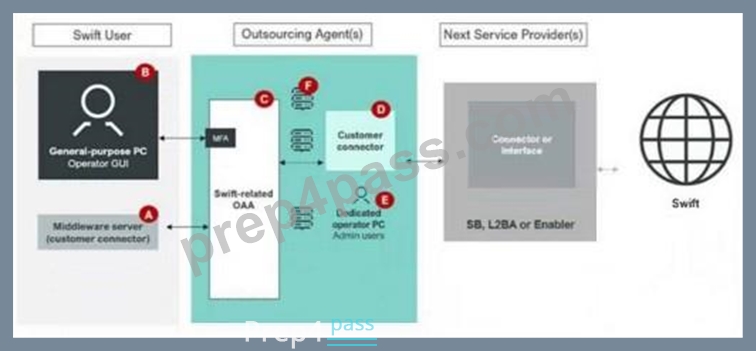
- A. Components A and B
- B. Components C, D and E
- C. Components A, B, C, D and E
- D. None of the above
Answer: C
NEW QUESTION # 50
Is it necessary to formally explain to the Swift user the testing methodology that will be used for the CSP assessment during the kick-off?
- A. No
- B. Yes
Answer: B
NEW QUESTION # 51
The internet connectivity restriction control prevents having internet access on any CSCE m-scope components.
- A. FALSE
- B. TRUE
Answer: A
Explanation:
This question addresses the internet connectivity restriction control and its application to CSCF in-scope components. Let's verify this against Swift CSP guidelines.
Step 1: Understand the Internet Connectivity Restriction Control
TheSwift Customer Security Controls Framework (CSCF) v2024, underControl 2.6: Internet Accessibility Restriction, mandates that in-scope components (e.g., Swift messaging interfaces, communication interfaces) must not have direct internet access to prevent exposure to external threats. However, this control allows for exceptions under specific conditions.
Step 2: Analyze the Statement
The statement claims that the internet connectivity restriction control "prevents having internet access on any CSCF in-scope components." The key is to determine if this is an absolute prohibition or if exceptions exist.
Step 3: Evaluate Against CSCF Guidelines
* Control 2.6: Internet Accessibility Restrictionrequires that Swift-related systems be isolated from the internet to minimize attack surfaces. This includes components like messaging interfaces (e.g., Alliance Access) and communication interfaces (e.g., SNL).
* However, theCSCF v2024andSwift CSP FAQallow for controlled internet access under specific circumstances, such as:
* Use of secure tunnels (e.g., VPNs) or proxies for authorized management purposes.
* Temporary access for software updates or patches, provided it is tightly controlled and monitored (perControl 6.1: Security Event Logging).
* The control does not impose an absolute ban but requires that any internet access be restricted, audited, and justified. Thus, the statement that it "prevents having internet access on any CSCF in-scope components" is too absolute.
Step 4: Conclusion and Verification
The statement isFALSEbecause, while internet access is heavily restricted for in-scope components, it is not entirely prevented under all circumstances (e.g., controlled access for maintenance). This aligns with the flexible yet secure approach of theCSCF v2024.
References
* Swift Customer Security Controls Framework (CSCF) v2024, Control 2.6: Internet Accessibility Restriction.
* Swift CSP FAQ, Section: Internet Access Exceptions.
NEW QUESTION # 52
In the illustration, identify which components are in scope of the CSCF? (Choose all that apply.)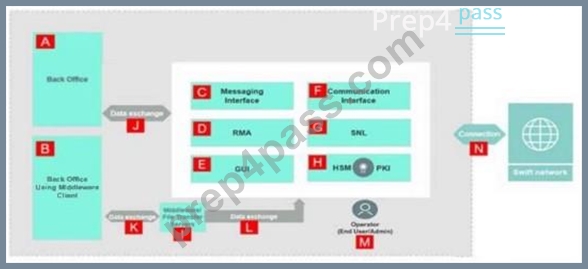
- A. Components C, E, M
- B. Components A, B, K
- C. Components J, K, I
- D. Components F, G, H
Answer: A
NEW QUESTION # 53
......
Swift CSP-Assessor Exam Syllabus Topics:
| Topic | Details |
|---|---|
| Topic 1 |
|
| Topic 2 |
|
| Topic 3 |
|
Free CSP-Assessor Exam Files Downloaded Instantly 100% Dumps & Practice Exam: https://passguide.prep4pass.com/CSP-Assessor_exam-braindumps.html
