Three different versions available for you
On account that different people have different preference for different versions of DSA-C03 exam braindumps: SnowPro Advanced: Data Scientist Certification Exam, our company has put out three kinds of different versions for our customers to choose from, namely, PDF Version, PC test engine and APP test engine of Snowflake DSA-C03 dumps guide. It is universally acknowledged that PDF version is convenient for you to read and print, therefore, you can bring the DSA-C03 exam simulation files with you wherever you go. What's more, among the three versions, the PC version can stimulate the real exam for you in the internet, but this version of Snowflake DSA-C03 exam simulation only can be operated in the windows operation system under Java script, which can help you to become familiar with the exam atmosphere in the real exam. We will respect every select that you make and will spare no effort to provide the best service and DSA-C03 exam braindumps: SnowPro Advanced: Data Scientist Certification Exam for you.
Instant Download: Upon successful payment, Our systems will automatically send the product you have purchased to your mailbox by email. (If not received within 12 hours, please contact us. Note: don't forget to check your spam.)
Instant downloading after payment
Customers' satisfaction is our greatest pursuit, so our company has paid great importance to the delivery speed. As our Snowflake DSA-C03 dumps guide materials are electronic files we do not need traditional shipping method. In order to save as much time as possible for our customers, our system will send the downloading link of DSA-C03 exam braindumps: SnowPro Advanced: Data Scientist Certification Exam to your e-mail address in 5 to 10 minutes automatically after payment (please enter the right email while placing the order), then you only need to check your email and download the DSA-C03 dumps guide, thus you can get enough time to prepare for the exam, as it is known to all, chance favors the one with a prepared mind. Our Snowflake DSA-C03 exam simulation files have been highly valued by a large number of people all over the world, you might as well have a try, and experience will tell you everything.
The shortcut for busy workers
However, preparing for the certificate exam is a hard & time-consuming process because the exam is very difficult and the pass rate is low if you prepare yourself without the help of our Snowflake DSA-C03 dumps guide. However most of people who need to prepare for the exam are office stuff and who are busy & tired in their daily lives, they may not have enough time to prepare for exam without valid DSA-C03 exam braindumps: SnowPro Advanced: Data Scientist Certification Exam. In order to help candidates get out of the dilemma, we are here to provide the shortcut for you. Our company specializes in compiling the Snowflake DSA-C03 exam bootcamp for workers, and we will be here waiting for helping you any time.
Undoubtly in the process of globalization, competition in various industries is likely to be tougher and tougher, (DSA-C03 exam braindumps: SnowPro Advanced: Data Scientist Certification Exam) and the industry is not an exception. As a worker, how can you stand out in the crowd? Maybe this certification can be the most powerful tool for you.

Snowflake DSA-C03 Exam Syllabus Topics:
| Section | Weight | Objectives |
|---|---|---|
| Topic 1: Data Science Concepts | 10%–15% | - Data Science Workflow
|
| Topic 2: Snowflake Data Science Best Practices | 15%–20% | - Security and Governance
|
| Topic 3: Generative AI and LLM Capabilities | 10%–15% | - GenAI in Snowflake
|
| Topic 4: Model Development and Machine Learning | 25%–30% | - Model Training
|
| Topic 5: Data Preparation and Feature Engineering | 25%–30% | - Data Preparation
|
Snowflake SnowPro Advanced: Data Scientist Certification Sample Questions:
1. A telecom company, 'ConnectPlus', observes that the individual call durations of its customers are heavily skewed towards shorter calls, following an exponential distribution. A data science team aims to analyze call patterns and requires to perform hypothesis testing on the average call duration. Which of the following statements regarding the applicability of the Central Limit Theorem (CLT) in this scenario are correct if the sample size is sufficiently large?
A) The CLT is applicable, and the sample mean will converge to the population median.
B) The CLT is applicable, and the distribution of sample means of call durations will approximate a normal distribution, regardless of the skewness of the individual call durations.
C) The CLT is not applicable because the population distribution (call durations) is heavily skewed.
D) The CLT is applicable as long as the sample size is reasonably large (typically n > 30), and the distribution of sample means will be approximately normal. The specific minimum sample size depends on the severity of the skewness.
E) The CLT is applicable only if the sample size is extremely large (e.g., greater than 10,000), due to the exponential distribution's heavy tail.
2. You are working with a Snowflake table named 'CUSTOMER DATA' that contains personally identifiable information (PII), including customer names, email addresses, and phone numbers. Your team needs to perform exploratory data analysis on this data to understand customer demographics and behavior. However, you must ensure that the PII is protected and that only authorized personnel can access the sensitive information. Which of the following strategies should you implement in Snowflake to achieve secure EDA?
A) Create a copy of the 'CUSTOMER DATA table without the PII columns and grant 'SELECT' privileges on this copy to the data scientists. Use masking policies on the original table.
B) Use transient tables to store the customer data after PII is obfuscated, drop the table and reload new data daily.
C) Grant 'SELECT privileges on the 'CUSTOMER DATA' table to all data scientists, and rely on them to avoid querying PII columns directly.
D) Apply dynamic data masking to the entire 'CUSTOMER_DATA' table, masking all columns by default, and provide decryption keys only to authorized users.
E) Create a view on top of that excludes the PII columns (e.g., name, email, phone). Grant 'SELECT privileges on this view to data scientists. Also implement data masking policies on the 'CUSTOMER DATA' table for the PII columns and grant 'SELECT on the table to specific roles requiring access to the masked values.
3. You are building a multi-class classification model in Snowflake to predict the category of customer support tickets (e.g., 'Billing', 'Technical Support', 'Sales Inquiry', 'Account Management', 'Feature Request') based on the ticket's text content. The initial model evaluation shows an overall accuracy of 75%, but the 'Feature Request' category has a significantly lower precision and recall compared to other categories. Which of the following strategies would be MOST effective in addressing this issue, considering the limitations and advantages of Snowflake's data processing capabilities and typical machine learning practices?
A) Apply a cost-sensitive learning approach during model training, assigning a higher misclassification cost to errors involving the 'Feature Request' category. This encourages the model to prioritize correctly classifying feature requests.
B) All of the above.
C) Oversample the 'Feature Request' category in the training dataset before training the model. This involves creating synthetic data points or duplicating existing data to balance the class distribution. This can be done using SQL and Snowflake's internal stage for storing temporary data before training.
D) Increase the threshold for classifying a ticket as 'Feature Request' to improve precision, even if it further reduces recall. This prioritizes accurate identification of feature requests over capturing all of them.
E) Engineer new features specifically designed to improve the model's ability to distinguish 'Feature Request' tickets from other categories. This could involve creating sentiment scores for 'innovation' or using topic modeling to identify key themes related to feature requests.
4. You are developing a churn prediction model and want to track its performance across different model versions using the Snowflake Model Registry. After registering a new model version, you need to log evaluation metrics (e.g., AUC, F 1-score) and custom tags associated with the training run. Assuming you have a registered model named 'churn_model' with version 'v2', which of the following code snippets demonstrates the correct way to log these metrics and tags using the Snowflake Python Connector and the 'ModelRegistry' API?
A) 
B) 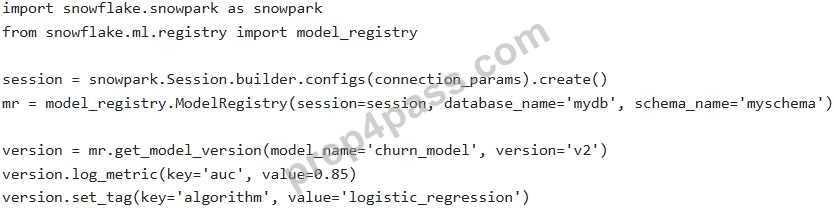
C) 
D) 
E) 
5. You are tasked with building a data pipeline using Snowpark Python to process customer feedback data stored in a Snowflake table called FEEDBACK DATA'. This table contains free-text feedback, and you need to clean and prepare this data for sentiment analysis. Specifically, you need to remove stop words, perform stemming, and handle missing values. Which of the following code snippets and strategies, potentially used in conjunction, provide the most effective and performant solution for this task within the Snowpark environment?
A) Leverage Snowflake's built-in string functions within SQL to remove common stop words based on a predefined list. Use a Snowpark DataFrame to execute this SQL transformation. For stemming, research and deploy a Java UDF implementing stemming algorithms, then chain it within a Snowpark transformation pipeline. Replace missing values with the string 'N/A' during the DataFrame construction using 'na.fill('N/A')'.
B) Load the FEEDBACK DATA' table into a Pandas DataFrame using perform stop word removal and stemming using libraries like spacy or NLTK, handle missing values using Pandas' 'fillna()' method. Then, convert the cleaned Pandas DataFrame back into a Snowpark DataFrame. Use vectorization of text column in dataframe after above step
C) Implement all data cleaning tasks within a single SQL stored procedure including removing stop words using REPLACE functions, stemming using a custom lookup table, and handling NULL values using COALESC Call this stored procedure from Snowpark for Python.
D) Utilize Snowpark's 'call_function' with a Java UDF pre-loaded into Snowflake, which removes stop words and performs stemming with libraries like Lucene. Missing values can be handled with SQL's 'NVL' function during the initial data extraction into a Snowpark DataFrame.
E) Use a Python UDF that utilizes the NLTK library to remove stop words and perform stemming on the feedback text. Handle missing values by replacing them with an empty string using the .fillna(")' method on the Snowpark DataFrame after applying the UDF.
Solutions:
| Question # 1 Answer: B,D | Question # 2 Answer: A,E | Question # 3 Answer: B | Question # 4 Answer: B | Question # 5 Answer: A,D |



 Montague
 Gail
Gail 
 Lance
Lance  Montague
  Mirabelle
 Eileen
  Mike
Mike  Wendy
Wendy  Scott
Scott  Viola
Viola  Roderick
  Rupert
  Ron
Ron  Joa
Joa  Eugene
  Les
Les  Hyman
Hyman