Three different versions available for you
On account that different people have different preference for different versions of 300-515 exam braindumps: Implementing Cisco Service Provider VPN Services, our company has put out three kinds of different versions for our customers to choose from, namely, PDF Version, PC test engine and APP test engine of Cisco 300-515 dumps guide. It is universally acknowledged that PDF version is convenient for you to read and print, therefore, you can bring the 300-515 exam simulation files with you wherever you go. What's more, among the three versions, the PC version can stimulate the real exam for you in the internet, but this version of Cisco 300-515 exam simulation only can be operated in the windows operation system under Java script, which can help you to become familiar with the exam atmosphere in the real exam. We will respect every select that you make and will spare no effort to provide the best service and 300-515 exam braindumps: Implementing Cisco Service Provider VPN Services for you.
Instant Download: Upon successful payment, Our systems will automatically send the product you have purchased to your mailbox by email. (If not received within 12 hours, please contact us. Note: don't forget to check your spam.)
Topics of Implementing Cisco Service Provider VPN Services (300-515 SPVI) Exam
These core topics isted below are general recommendations for the material that is likely to be used for the examination. However, on any particular delivery of the test, other similar topics could also appear. The guidelines below can update at any time without notice to better represent the contents of the exam and for clarity purposes.
It is recommended that, where possible, the applicant use these courses and/or other resources to provide background information on the exam objectives. The syllabus for the Implementing Cisco Service Provider VPN Services (300-515 SPVI) examination is listed below in detail of each section and their topics:
1. VPN Architecture (25%)
Objectives covered by this section:
Objective 1.1 - Compare VPN architecture:
- Layer 2 and Layer 3 VPN
- Inter-AS and Intra-AS
Objective 1.2 - Troubleshoot underlay:
- Core IGP
- LSP
Objective 1.3 - Describe Layer 2 service architecture:
- IOS XE Ethernet Virtual Circuits
- IOS XR Ethernet Flowpoints
Objective 1.4 - Describe the L3VPN control plane operation:
- Route target
- VRF routing instance
- Route distinguisher
- VPN label
- MP-BGP
- VPNv4 address
- PE-CE route advertisement
Objective 1.5 - Describe the L3VPN data plane operation:
- VRF forwarding instance
- Underlay label
2. Layer 2 VPNs (30%)
Objectives covered by this section:
Objective 2.1 - Troubleshoot L2VPN Services:
- E-Tree
- E-LAN
- E-Line
Objective 2.2 - Describe EVPN concepts:
- Data plane and control plane operation
- Traffic forwarding operation
- Suppression mechanisms
- Multihoming mechanisms
Objective 2.3 - Implement Ethernet Operations, Administration, and Maintenance (E-OAM)
Objective 2.4 - Implementing EVPN:
- EVPN IRB
- EVPN native
- EVPN VPWS
3. Layer 3 VPNs (35%)
Objectives covered by this section:
Objective 3.1 - Describe routing requirements:
- PE-CE routing protocol
- MP-BGP
Objective 3.2 - Troubleshoot Intra-AS L3VPNs:
- PE-PE
- PE-CE
- PE-RR
Objective 3.3 - Implement multicast VPN:
- Intranet MVPN
- MLDP
- Extranet MVPN
Objective 3.4 - Implement extranet/shared services:
- Import and export route targets
- Route policy
Objective 3.5 - Describe Inter-AS L3VPNs:
- Option B
- Option C
- Option A
- Option AB
Objective 3.6 - Describe CSC concepts:
4. IPv6 VPNs (10%)
Objectives covered by this section:
Objective 4.1 - Describe routing requirements:
- PE-CE routing protocol
- MP-BGP
Objective 4.2 - Troubleshoot IPv6 VPN provider edge:
- PE-PE
- PE-CE
Instant downloading after payment
Customers' satisfaction is our greatest pursuit, so our company has paid great importance to the delivery speed. As our Cisco 300-515 dumps guide materials are electronic files we do not need traditional shipping method. In order to save as much time as possible for our customers, our system will send the downloading link of 300-515 exam braindumps: Implementing Cisco Service Provider VPN Services to your e-mail address in 5 to 10 minutes automatically after payment (please enter the right email while placing the order), then you only need to check your email and download the 300-515 dumps guide, thus you can get enough time to prepare for the exam, as it is known to all, chance favors the one with a prepared mind. Our Cisco 300-515 exam simulation files have been highly valued by a large number of people all over the world, you might as well have a try, and experience will tell you everything.
Introduction to Implementing Cisco Service Provider VPN Services (300-515 SPVI) Exam
It is a 90-minute test affiliated with the CCNP Service Provider and Cisco Accredited Professional-Service Provider VPN Services Implementation certifications. Implementing Cisco Service Provider VPN Services (300-515 SPVI) exam tests the candidate's knowledge of integrating VPN services, including Layer 2, Layer 3, and IPv6, from the service provider. The course, Integrating VPN Services from Cisco Service Provider, allows applicants to prepare for this exam.
This exam measures your understanding of the implementation of VPN services for service providers, including:
- Layer 3
- IPv6
- Layer 2
The shortcut for busy workers
However, preparing for the certificate exam is a hard & time-consuming process because the exam is very difficult and the pass rate is low if you prepare yourself without the help of our Cisco 300-515 dumps guide. However most of people who need to prepare for the exam are office stuff and who are busy & tired in their daily lives, they may not have enough time to prepare for exam without valid 300-515 exam braindumps: Implementing Cisco Service Provider VPN Services. In order to help candidates get out of the dilemma, we are here to provide the shortcut for you. Our company specializes in compiling the Cisco 300-515 exam bootcamp for workers, and we will be here waiting for helping you any time.
Conclusion
With key concepts and skills regarding networking and core technologies about the Service Provider, beginning your training and preparation for the Cisco 300-515 exam would be easier. With a commitment to the exam subject matter, you should manage the whole procedure including passing the final validation itself. The skills from such a test and the CCNP Service Provider certificate are ideal for great roles in networking that are always in demand. So, even as you prepare, keep reflecting on what awaits you!
Undoubtly in the process of globalization, competition in various industries is likely to be tougher and tougher, (300-515 exam braindumps: Implementing Cisco Service Provider VPN Services) and the industry is not an exception. As a worker, how can you stand out in the crowd? Maybe this certification can be the most powerful tool for you.

Study Guide to Help in 300-515 Exam Preparation
For outstanding tips on how to prepare and pass the Cisco 300-515 exam, there is a study guide designed for your utilization. The ‘How I Passed Implementing Cisco Service Provider VPN Services (300-515 SPVI) Exam: Successfully Proven Tips’ eBook on Amazon written by Rocismo Liolentz Publications enables those wishing to attempt the final exam to discover the concepts and methodologies that aid during preparation. It is a systematic guide offering proven exam prep tips. It also shares the approach that would be most appropriate during the answering of questions when taking on the official test.
Cisco 300-515 Exam Syllabus Topics:
| Section | Weight | Objectives |
|---|---|---|
| Layer 2 VPNs | 30% | - Troubleshoot L2VPN services (E-LAN, E-Line, E-Tree) - Implement EVPN (IRB, VPWS, native) - Describe EVPN concepts (data plane/control plane, multihoming, suppression, forwarding) - Implement Ethernet OAM |
| VPN Architecture | 25% | - Troubleshoot underlay (Core IGP, LSP) - Describe L3VPN data plane (underlay label, VRF forwarding, VPNv6) - Compare VPN architecture (Layer 2 vs Layer 3, Inter-AS/Intra-AS) - Describe L3VPN control plane (MP-BGP, RD, RT, VPN labels, VRF, PE-CE) - Describe Layer 2 service architecture (IOS XR Ethernet Flowpoints, IOS XE EVCs) |
| IPv6 VPNs | 10% | - Troubleshoot IPv6 VPN provider edge (PE-PE, PE-CE) - Describe IPv6 VPN routing requirements (MP-BGP, PE-CE) |
| Layer 3 VPNs | 35% | - Describe routing requirements (MP-BGP, PE-CE routing) - Implement extranet/shared services (route targets/policy) - Describe Inter-AS L3VPNs (Options A, B, AB, C) - Describe CSC concepts - Implement multicast VPN (Intranet, Extranet, mLDP) - Troubleshoot Intra-AS L3VPNs (PE-CE, PE-PE, PE-RR) |
Cisco Implementing Cisco Service Provider VPN Services Sample Questions:
Refer to the exhibit. If the two devices are operating normally, which two conclusions can you draw from this configuration? (Choose two.)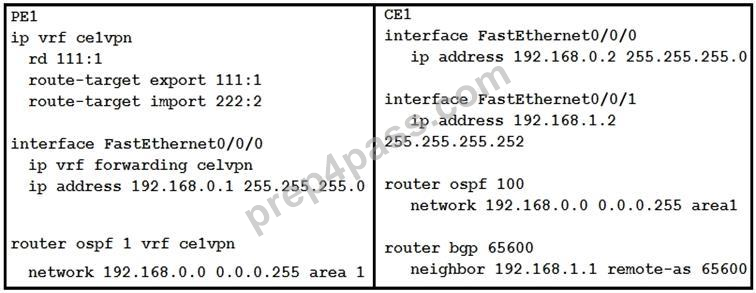
- A. PE1 labels the routes it learns from CE1 with the route-target 222:2 and shares them with its VPNv4 peers.
- B. The PE-CE routes between the devices are being exchanged by OSPF
- C. PE1 labels the routes it learns from CE1 with the route-target 111:1 and shares them with its VPNv4 peers.
- D. CE1 is supporting CSC.
- E. CE1 must use OSPF to establish a neighbor relationship with PE1.
Correct Answer: B,C 🗳️
Explanation: Only visible for Prep4pass members. You can sign-up / login (it's free).
Refer to the exhibit. R2 is connected to a server that is used heavily by numerous hosts that reside on R1. The company's network monitoring software flagged the Ethernet link between R1 and R2 for occasional instability in its data transmission. A network engineer must observe the traffic patterns and improve transmission in real time. Which action must the engineer take to meet this requirement?
- A. Implement traffic shaping to queue packets when traffic from R1 to R2 exceeds a set threshold.
- B. Implement E-OAM and configure link monitoring to disable the interface when it becomes unstable.
- C. Configure system alerts to email a log message to the network monitoring system when traffic is too high.
- D. Configure CBWFG to assign a VLAN tag to untagged packets and redirect them via R6 when traffic is high.
Correct Answer: A 🗳️
Explanation: Only visible for Prep4pass members. You can sign-up / login (it's free).
SIMULATION 2
Guidelines
This is a lab item in which tasks will be performed on virtual devices.
Refer to the Tasks tab to view the tasks for this lab item
Refer to the Topology tab to access the device console(s) and perform the tasks.
Console access is available for all required devices by clicking the device icon or using the
tab(s) above the console window.
All necessary pre-configurations have been applied.
Do not remove any existing configurations from the devices, only those necessary to make the
appropriate changes required to fulfill the listed tasks.
Do not change the enable password or hostname for any device.
Save your configurations to NVRAM before moving to the next item.
Click Next at the bottom of the screen to submit this lab and move to the next question.
When Next is clicked, the lab closes and cannot be reopened.
Tasks
CE1 and CE2 are IPv6 Customer Premise Equipment of two customers that communicate with each other through the MPLS L3VPN core comprising Provide Edge PE1, PE2, and route- reflector RR.
Perform the below configuration and verification tasks as noted.
1. Modify the PEs to allow the CEs to communicate with each other over their Loopback 0 addresses.
2. Modify PE1 to receive CE2's loopback1 address and advertise to CE1.
Initial configuration with IPv6 addressing has been completed. Do not change the configurations except to fulfill the abovementioned tasks. Apply the solution with the minimum configuration.
Topology
PE1

CE1

CE2
Correct Answer:
On PE1 and PE2:
1. Under address-family vpnv6
neighbor 10.3.3.3 activate
Brings up the MP-BGP session to RR for IPv6 routes.
neighbor 10.3.3.3 send-community extended
Ensures the Route Distinguisher/RT are carried so remote PEs know which VRF to install these routes into.
2. Under address-family ipv6 vrf ABC
neighbor <CE-link-IPv6> activate
(If not already present) activates the PE-CE IPv6 BGP neighbor so the PE will receive the CE's Loopback-0/32.
redistribute connected
Picks up the CE's directly-connected loopback subnet on the PE and advertises it into the MP- BGP IPv6-VPN (vpnv6) table.
Which kind of traffic is supported in an MVPN Extranet?
- A. PIM dense mode
- B. PIM sparse mode
- C. Bidirectional PIM
- D. PIM dense mode with Reverse Path Forwarding
Correct Answer: B 🗳️
How do VRFs assist ISPs in providing services to multiple customers?
- A. by using both IP and MPLS to forward in the core
- B. by allowing an ISP to segregate customer routing tables while using the same hardware
- C. by providing the ability to transmit Layer 3 traffic using AToM
- D. by enabling the use of different media types to support connections of varying lengths
Correct Answer: B 🗳️
Explanation: Only visible for Prep4pass members. You can sign-up / login (it's free).
Viewing page 1 out of 36 pages.
Viewing questions 1-5 out of 178 questions.


 Carter

 Chad
 Barry
 Stev

 Suzanne
 Brook

 Sigrid
 Saxon
 Ivy
 Marsh
 Kerr
 Lewis
 Haley
 Cyril
 April
 Nick
 Bonnie
 King
 Moore
 Jo
 Tiffany
 Larry
 Queena
 Harry