Favorable price for the best products
Although our SPS-C01 exam braindumps have received the warm reception and quick sale from all over the world, in order to help as many workers as possible to pass the exam and get the dreaming certification successfully, we still keep a favorable price for our best SPS-C01 exam simulation. We assure you that our products are reasonable price with high quality. If you choose us you will choose the best high pass-rate Snowflake SPS-C01 reliable questions and answers. We aim at providing the best training materials for our users, and we will count it an honor to provide sincere service for you.
Instant Download: Upon successful payment, Our systems will automatically send the product you have purchased to your mailbox by email. (If not received within 12 hours, please contact us. Note: don't forget to check your spam.)
High pass rate
The pass rate of IT exam is the most essential criteria to check out whether our SPS-C01 exam simulation files are effective or not undoubtly. Seriously, I want to say that according to statistics, under the help of our products, the pass ratio of SPS-C01 exam braindumps files have reached as high as 98% to 100% based on the past experience. We are growing larger and larger because our valid SPS-C01 reliable questions and answers are the fruits of painstaking efforts of a large number of top workers all over the world. Our Snowflake SPS-C01 exam simulation files have been honored as the best shortcut for workers in this filed since all of the contents of SPS-C01 exam braindumps files are the essences of the exam. What's more, all of the key points and the real question types of the exam are included in our exam preparation materials. With the help of our SPS-C01 reliable questions and answers you can be confident that you will pass the exam surely and get your dreaming certification as easy as turning over your hands. So why are you still waiting for? Just take immediate actions!
Obviously everyone expects to get a desired job and promotion as well as a big pay raise in his or her career (Snowflake SPS-C01 exam braindumps). If you are a worker, maybe the certification will be of great significance for you to achieve your goal. But meanwhile, the Snowflake SPS-C01 exam is always "a lion in the way" or "a stumbling block" for many people because it is too difficult for many candidates to pass (SPS-C01 exam simulation). Now, since you have clicked into this website, your need not to worry about that any longer, because our company can provide the best remedy for you--our Snowflake SPS-C01 reliable questions and answers files.
Our company has been committed to edit the valid SPS-C01 exam simulation for workers during the 8 years, and now we would like to share our great achievements with you in order to help you to pass the exam as well as get the certification easily. The strong points of our SPS-C01 exam braindumps are as follows.

Trial experience before purchasing
Our company is the leading position in the field, and our SPS-C01 exam simulation files are well received in most countries of the world, but if you still have any misgivings, you can download the free demo of SPS-C01 reliable questions and answers on the page which will only take you a few minutes, just like an old saying goes: "bold attempt is half success." We believe that the free trial test will let you know why our SPS-C01 exam braindumps are so popular in the world. This is really a great opportunity for you to study efficiently and pass exam easily with Snowflake SPS-C01 exam simulation, which will provide you only convenience and benefits. You should not miss it!
Snowflake SPS-C01 Exam Syllabus Topics:
| Section | Weight | Objectives |
|---|---|---|
| Data Transformations and DataFrame Operations | 35% | - Filtering, Aggregating, and Joining DataFrames - Window functions - Persisting transformed data - Complex data pipelines - Using built-in functions |
| Performance Optimization and Best Practices | 20% | - Query pushdown and optimization - Caching strategies - Debugging and explain plans - Vectorized UDFs - Minimizing data transfer - Warehouse sizing for Snowpark |
| Snowpark Concepts | 15% | - Stored procedures and conditional logic - Transformations vs. Actions - Snowpark architecture and core concepts - Snowpark Sessions and connection management - Client-side vs. Server-side execution - Snowpark DataFrames and query plans |
| Snowpark API for Python | 30% | - Establishing connections and session management - User-Defined Functions (UDFs) and Stored Procedures - Reading and writing data - Working with Semi-structured data - DataFrame creation and manipulation |
Snowflake Certified SnowPro Specialty - Snowpark Sample Questions:
You have a SQL query stored in a file named 'query.sqr which contains several complex analytical calculations. The query depends on a Snowpark 'session' object already established. You want to create a Snowpark DataFrame from the result of this query. Which of the following code snippets achieves this with optimal performance and readability, assuming correct file access permissions?
- A.
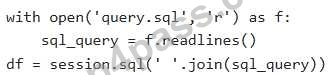
- B.

- C.

- D.

- E.

Correct Answer: D 🗳️
Explanation: Only visible for Prep4pass members. You can sign-up / login (it's free).
You have a Snowpark DataFrame containing customer data'. You need to create a stored procedure that accepts the DataFrame and a list of column names as input and returns a new DataFrame containing only the specified columns. Which of the following approaches correctly implement this functionality and handles data types effectively (Select all that apply)?
- A.

- B.

- C.

- D.

- E.

Correct Answer: B,C 🗳️
Explanation: Only visible for Prep4pass members. You can sign-up / login (it's free).
Consider the following Snowpark Python code snippet:
- A. This code requires a configured Anaconda environment to run successfully.
- B. The function will retrieve all rows from the 'customers' table and store them in a local Pandas DataFrame before applying the function.
- C. The code demonstrates the Snowpark architecture, where transformations are translated into SQL and executed in Snowflake's engine. Only the final 'collect()' brings the results back to the client.
- D.

- E. The 'upper()' function will be executed on the client-side (where the Python code is running) for each row in the 'customers' table.
Correct Answer: C,D 🗳️
Explanation: Only visible for Prep4pass members. You can sign-up / login (it's free).
You have a Snowpark application that reads data from a large Snowflake table and performs several transformations. During testing, you observe that the application's performance is inconsistent, with some runs taking significantly longer than others, even with the same input data'. You suspect that data locality might be a contributing factor. What steps can you take within your Snowpark application to investigate and potentially improve data locality and performance consistency?
- A. Ensure the Snowpark session is configured with a large enough warehouse size to minimize data spilling to disk.
- B. Disable Snowflake's result cache. This ensures that the application always reads the most recent data from disk, regardless of performance impact.
- C. Implement caching using , combined with a targeted 'repartition()' to ensure that frequently accessed data is readily available in memory close to the processing nodes.
- D. Use to redistribute the data across the cluster based on a relevant key. This can improve data locality for subsequent operations.
- E. Enable Snowflake's automatic clustering on the underlying table if it's not already enabled. This will physically organize the data on disk based on the clustering key.
Correct Answer: C,D,E 🗳️
Explanation: Only visible for Prep4pass members. You can sign-up / login (it's free).
You have two Snowpark DataFrames: containing customer information and 'orders_df containing order details. You need to merge these DataFrames based on the column to create a unified view. The 'customers_df may contain duplicate values. The contains recent orders. You want to use 'merge' with an 'UPDATE action based on 'customer id' and a 'WHEN NOT MATCHED BY TARGET action to insert new customer records from 'customers df into the 'orders df table that do not exist.
- A. The 'merge' operation will succeed, processing each matching record sequentially. If more than one row matches it will process based on order in the dataframe
- B. The 'merge' operation will fail immediately upon encountering the first duplicate key during the update operation. Consider stage the source dataframe and use an appropriate dedup option with merge.
- C. The merge operation cannot handle duplicate keys in the source DataFrame without pre-aggregation.
- D. The 'UPDATE action in 'merge' will update all matching rows in the target table based on the join condition, regardless of duplicates in the source.
- E. You must use on the source DataFrame ('customers_df) before using 'merge' to ensure only one matching row exists per customer.
Correct Answer: C 🗳️
Explanation: Only visible for Prep4pass members. You can sign-up / login (it's free).
Viewing page 1 out of 75 pages.
Viewing questions 1-5 out of 374 questions.



 Conrad
 Paula
Paula 
 Eleanore
 Laura
Laura  Hermosa
  Carey
Carey  Evelyn
  Ira
Ira  Bob
Bob  Augustine
  Beryl
Beryl  Archer
  Maurice
  Cecilia